

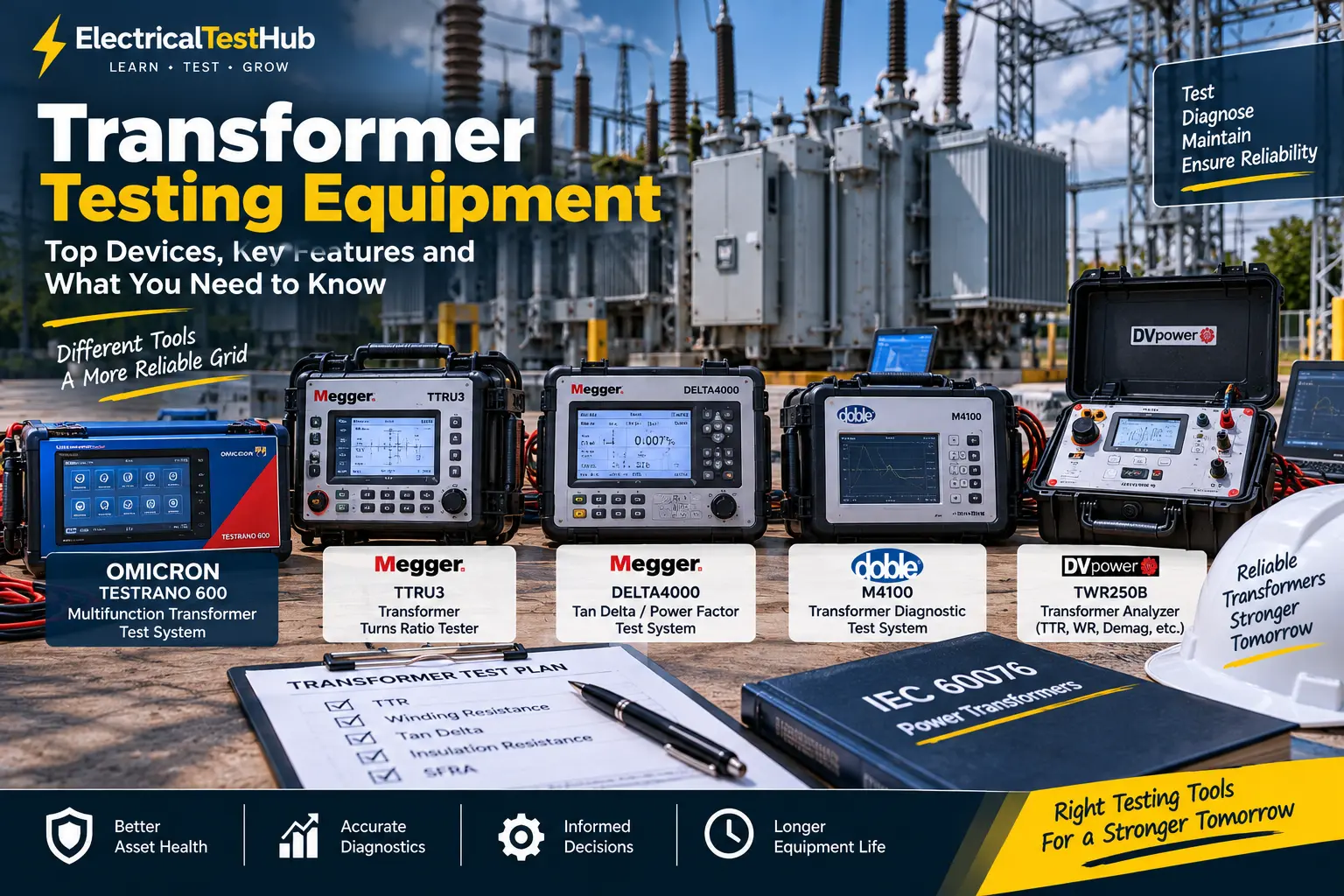
Transformer testing is not performed with one universal instrument.
Depending on the type of transformer and the information required, engineers may use different test equipment for:
- Transformer turns ratio
- Winding resistance
- Tan delta / power factor
- Capacitance
- Excitation current
- Sweep Frequency Response Analysis (SFRA)
- Insulation condition
- On-load tap changer assessment
- Short-circuit impedance
- Other diagnostic measurements
For someone new to transformer testing, the number of different instruments can be confusing.
You may see equipment from manufacturers such as:
- OMICRON
- Megger
- Doble
- DV Power
- Vanguard
- AEMC and other specialist manufacturers
The important thing to understand is that these instruments are not all interchangeable.
Some are designed for one specific measurement, while others combine several transformer tests into one platform.
This article focuses only on transformer testing devices and test equipment. It does not explain the detailed testing procedures themselves.
Important: The equipment capabilities, ratings, accessories, and software options can vary by model and configuration. Always verify the current manufacturer documentation before using a test set.
What Is Transformer Testing Equipment?
Transformer testing equipment is specialized electrical test instrumentation used to measure or evaluate different electrical characteristics of a transformer.
A typical transformer test setup may include:
- Test instrument
- HV and LV test cables
- Kelvin leads
- Grounding cable
- Tap-changer connection
- Computer or control software
- Safety accessories
- Calibration documentation
The test instrument generates a controlled electrical signal or current and measures the response of the transformer.
The resulting data can then be recorded and analyzed.
A useful way to understand transformer test equipment is:
The transformer is the test object; the test set provides the controlled stimulus and measurement.
Transformer Testing Equipment Can Be Divided Into Two Main Groups
For beginners, transformer test equipment can be divided into:
1. Dedicated Test Instruments
These instruments are designed mainly for one specific type of measurement.
Examples:
- Transformer turns ratio tester
- Winding resistance meter
- Tan delta / power factor tester
- SFRA analyzer
They are useful when a particular test is performed frequently.
2. Multifunction Transformer Test Systems
These systems combine several testing capabilities into one platform.
For example, a multifunction system may support:
- Turns ratio
- Winding resistance
- Excitation current
- Dynamic resistance
- Demagnetization
- Other transformer measurements
This can reduce the number of separate instruments required for a field testing team.
1. OMICRON TESTRANO 600
One of the well-known multifunction transformer test systems is the OMICRON TESTRANO 600.
OMICRON describes TESTRANO 600 as a portable three-phase test system for comprehensive testing of single- and three-phase power and distribution transformers. The manufacturer states that it supports routine and diagnostic testing both on-site and during factory acceptance testing.
What Can TESTRANO 600 Do?
Depending on configuration and software, TESTRANO 600 can support measurements including:
- Transformer turns ratio
- DC winding resistance
- Dynamic resistance
- Demagnetization
- Short-circuit impedance / leakage reactance
- Frequency response of stray losses
- OLTC scan / dynamic resistance
- Vector group check
- Excitation-related measurements
- Power/dissipation factor and capacitance when combined with the appropriate accessory
OMICRON states that the TESTRANO 600 uses a three-phase testing approach and can provide three-phase excitation for relevant measurements.
Why Is It Useful?
The main advantage for a field testing team is that several measurements can be performed using a common test setup.
This can reduce repeated cable reconnections and make the overall testing workflow more organized.
OMICRON also provides a Primary Test Manager (PTM) software environment for guided test workflows, data management, assessment, and reporting.
Beginner’s Understanding
Think of TESTRANO 600 as:
A multifunction transformer test platform rather than a single-purpose meter.
It is particularly attractive when a testing company performs several transformer tests regularly.
2. OMICRON CPC 100 + CP TD12/15
Another important OMICRON combination is the CPC 100 with the appropriate transformer-testing accessories.
The CPC 100 is a multifunction primary test system used across substation assets. When combined with the CP TD12/15, it can also perform capacitance and dissipation/power factor measurements.
The CP TD12/15 is designed for measurements such as:
- Tan delta / dissipation factor
- Capacitance
- Excitation current
- Power
- Impedance
- Current
- Phase angle
OMICRON specifies a 12 kV/15 kV high-voltage source depending on the CP TD model and describes the system as suitable for transformer and other high-voltage asset applications.
Why Is This Equipment Important?
A transformer testing engineer may encounter CPC 100-based test setups when performing a wider range of substation testing.
The important beginner concept is:
CPC 100 is a multifunction primary test platform, while accessories expand its testing capabilities for particular applications.
3. OMICRON FRANEO 800
Not every transformer test is about resistance or voltage ratio.
A transformer can also experience mechanical changes inside its winding structure.
For this type of diagnostic work, Sweep Frequency Response Analysis (SFRA) is commonly used.
OMICRON’s FRANEO 800 is a dedicated SFRA test system for transformer diagnostics.
It is intended to help identify changes associated with transformer winding and core structures.
For a beginner, the important distinction is:
- TESTRANO 600 → multifunction transformer electrical testing
- CP TD12/15 → capacitance / tan delta related measurements
- FRANEO 800 → SFRA / frequency response diagnostics
Do not think of all three as interchangeable instruments.
4. Megger TTRU3
Megger is another major manufacturer of electrical test equipment.
The TTRU3 is a dedicated three-phase transformer turns ratio tester.
Megger states that TTRU3 provides three-phase simultaneous TTR testing and a specified transformer turns-ratio accuracy of ±0.05%. It also supports testing of all taps of an on-load tap changer through its control functionality.
What Is the TTRU3 Used For?
The primary purpose is transformer turns ratio testing.
Depending on the application, it can also provide information such as:
- Excitation current
- Phase deviation
- Tap-related measurements
Megger describes the TTRU3 as using three-phase excitation and supporting complex transformer configurations.
Why Use a Dedicated TTR Tester?
A transformer turns ratio measurement may look simple in theory.
However, real three-phase transformers can have:
- Multiple windings
- Tap changers
- Different vector groups
- Complex connections
A dedicated instrument automates much of the measurement and calculation process.
5. Megger MTOU3
For transformer winding resistance, a different instrument is more appropriate.
Megger’s MTOU3 is a three-phase winding resistance ohmmeter designed for power, distribution, and instrument transformers.
Megger’s transformer resistance-testing portfolio is designed to measure winding resistance with high test currents and can support OLTC-related diagnostics depending on the model.
Why Is Winding Resistance Equipment Different?
A winding resistance test involves injecting DC current into the transformer winding and measuring the resulting voltage and current.
Transformer windings are inductive.
Therefore, the test equipment needs to manage:
- Current injection
- Measurement stabilization
- Stored magnetic energy
- Discharge
- Demagnetization where required
This is why a normal low-resistance multimeter is not a substitute for a dedicated transformer winding resistance test set.
6. Megger DELTA4000
For transformer insulation diagnostics, another important instrument is the Megger DELTA4000 series.
DELTA4000 is a 12 kV insulation power factor / tan delta test system.
Megger describes it as an automatic system for assessing the condition of electrical insulation and notes its ability to operate under high-noise conditions.
What Is It Mainly Used For?
For transformer applications, equipment in this category is used for measurements related to:
- Power factor
- Dissipation factor / tan delta
- Capacitance
- Insulation condition
The purpose is different from a TTR tester.
Simple Comparison
TTRU3
→ Primarily transformer ratio testing
MTOU3
→ Primarily winding resistance
DELTA4000
→ Primarily insulation power factor / tan delta and capacitance
This is a good example of why transformer testing requires different instruments.
7. Megger TRAX
Megger also offers the TRAX Multifunction Transformer and Substation Test System.
TRAX is designed as a multifunction system rather than a single-purpose transformer tester.
Megger describes TRAX as supporting multiple transformer and substation applications, including TTR and winding resistance, with optional capabilities for power factor/tan delta and other measurements depending on configuration.
Why Is TRAX Interesting?
It sits in a similar conceptual category to multifunction transformer systems:
One platform → multiple testing applications
This can be useful for testing organizations that need flexibility rather than purchasing a separate instrument for every test.
8. Doble M4100
Doble is another well-known manufacturer in the transformer diagnostic testing field.
The M4100 is a power factor/tan delta instrument designed for commissioning, diagnostic, and preventative testing.
Doble lists capabilities including:
- Power factor / tan delta
- Capacitance
- Turns ratio
- Leakage reactance / short-circuit impedance
- Excitation current
The system also works with Doble software for test assistance and result analysis.
What Makes M4100 Different?
The M4100 is particularly associated with insulation diagnostic measurements such as power factor/tan delta, while also providing additional transformer measurement capabilities.
Doble also provides software-based analysis tools that help users interpret test results.
For beginners, this illustrates an important trend in modern test equipment:
Modern transformer test sets increasingly combine measurement, automation, data storage, reporting, and analysis.
9. DV Power TWR250B
DV Power specializes in transformer and substation testing equipment.
The TWR250B is a three-phase transformer analyzer designed for:
- Winding resistance
- Turns ratio
- Excitation current
- Phase angle
- Demagnetization
- Vector group detection
DV Power states that the TWR250B can test multiple transformer windings with a single cable connection and provides automated test functions.
The manufacturer specifies up to 25 A DC for winding resistance testing and up to 250 V AC for turns-ratio testing on the TWR250B.
Why Is It Useful?
The TWR250B combines several commonly required transformer measurements into a relatively compact battery-powered field instrument.
This can be useful when testing teams need portability and multiple functions in one device.
10. DV Power Winding Resistance Meters
DV Power also produces dedicated transformer winding resistance meters such as the RMO-TW, RMO-TD and RMO-TT series.
These instruments are designed specifically around winding resistance and tap-changer analysis.
For example, the RMO-TT family is designed for transformer winding resistance measurement and OLTC analysis, with models offering high DC test currents and multiple measurement channels.
Dedicated vs Multifunction
This gives us another useful distinction:
Dedicated winding resistance tester
→ optimized for resistance and tap-changer work.
Multifunction transformer analyzer
→ combines several transformer measurements in one device.
Neither approach is automatically better.
The appropriate choice depends on the testing company’s requirements.
11. Handheld Transformer Testers
Not every transformer requires a large trolley-mounted test system.
For smaller distribution transformers, portable handheld equipment can be useful.
For example, DV Power’s TWR-H is a handheld battery-powered instrument designed for turns ratio and winding resistance measurements on single- and three-phase transformers.
The manufacturer specifies separate DC sources for HV and LV winding resistance measurements and an AC source for turns ratio measurements.
Where Is a Handheld Tester Useful?
It can be particularly practical for:
- Distribution transformers
- Smaller transformers
- Quick field measurements
- Situations where portability is important
However, a handheld instrument should not automatically be considered suitable for every transformer.
Always check its ratings and capabilities against the transformer being tested.
12. What About a Normal Multimeter?
A beginner may ask:
“Can I use a multimeter for transformer testing?”
A multimeter is useful for basic electrical measurements, but it is not a replacement for dedicated transformer test equipment.
A multimeter may help measure:
- Voltage
- Basic resistance
- Continuity
But professional transformer testing may require:
- Controlled excitation
- High DC test current
- Accurate low-resistance measurement
- Three-phase ratio measurement
- High-voltage insulation diagnostics
- Automated tap-changer testing
- SFRA
- Demagnetization
These require specialized equipment.
Therefore:
A multimeter is a general electrical measurement instrument, not a complete transformer testing system.
Dedicated Device vs Multifunction Device
This is one of the most important decisions for a testing company.
Dedicated Equipment
Examples:
- Dedicated TTR tester
- Dedicated winding resistance meter
- Dedicated tan delta tester
- Dedicated SFRA analyzer
Advantages
- Designed specifically for one application
- Often simple to operate
- Specialized measurement capability
- Useful when one test is performed frequently
Disadvantages
- More instruments may be required
- More equipment to transport
- More calibration records
- More storage requirements
Multifunction Equipment
Examples:
- OMICRON TESTRANO 600
- Megger TRAX
- DV Power TWR250B
- Other multifunction transformer analyzers
Advantages
- Multiple tests from one platform
- Less equipment to transport
- Common software environment
- Easier centralized reporting
Disadvantages
- Higher initial investment
- More complicated system
- Some functions may require optional accessories or licenses
- Users need broader training
How Should a Beginner Choose a Transformer Test Instrument?
Do not choose a test set simply because it is made by a famous manufacturer.
First identify the testing requirement.
Ask:
Question 1: What transformer will I test?
For example:
- Distribution transformer
- Power transformer
- Generator step-up transformer
- Auto-transformer
- Instrument transformer
Question 2: Which tests are required?
Do you need:
- TTR?
- Winding resistance?
- Tan delta?
- SFRA?
- Excitation current?
- OLTC testing?
Question 3: What is the voltage and size of the transformer?
The instrument must be suitable for the application.
Question 4: Do I need a dedicated instrument or multifunction system?
If your company performs one specific test frequently, a dedicated instrument may be practical.
If you perform many transformer tests, a multifunction platform may provide more flexibility.
Question 5: How important is portability?
For field testing, consider:
- Weight
- Case design
- Cable management
- Battery operation
- Site accessibility
Question 6: What software and reporting capabilities are required?
Modern testing is not only about measuring.
A testing system may also need to:
- Store test data
- Compare historical results
- Generate reports
- Export results
- Create test plans
- Manage asset history
A Beginner’s Transformer Test Equipment Roadmap
If you are new to transformer testing, do not try to learn every instrument simultaneously.
A practical learning sequence is:
Level 1 — Basic Measurement
Understand:
- Multimeter
- Clamp meter
- Basic resistance measurement
Level 2 — Core Transformer Test Equipment
Learn:
- TTR tester
- Winding resistance tester
Level 3 — Insulation Diagnostic Equipment
Learn:
- Tan delta / power factor test set
- Capacitance measurement equipment
- Insulation resistance tester
Level 4 — Advanced Diagnostic Equipment
Learn:
- SFRA analyzer
- Dielectric response analyzer
- Partial discharge equipment
Level 5 — Multifunction Transformer Systems
Learn platforms such as:
- OMICRON TESTRANO 600
- Megger TRAX
- DV Power transformer analyzers
This progression makes it easier to understand what each instrument actually does.
Important: The Test Instrument Does Not Decide the Acceptance Criteria
This is a very important concept for beginners.
Suppose an instrument displays:
Winding Resistance = 0.245 Ω
The instrument has measured the value.
But the instrument alone does not necessarily tell you whether that result is acceptable.
You may need to compare the result with:
- Transformer nameplate information
- Manufacturer requirements
- Applicable standards
- Factory test results
- Previous maintenance results
- Phase-to-phase comparison
- Temperature-adjusted values where applicable
The instrument provides the measurement.
The engineer interprets the measurement.
This is exactly why understanding test results is so important. You can read our previous guide:
Understanding Electrical Test Results: Why a Number Is Not Always Pass or Fail
Standards and Transformer Test Equipment
The correct test equipment should be selected according to the test requirement and applicable standard.
For transformer testing, standards from organizations such as IEC and IEEE may define or provide guidance on specific measurements and test methods.
For example, transformer standards in the IEC 60076 series cover different aspects of power transformers.
The instrument manufacturer may also provide test procedures, connection diagrams, accuracy specifications, and application guidance.
A useful rule is:
First identify the required test and applicable requirement; then select the instrument capable of performing that test correctly.
Do not start with the instrument and then try to find a test for it.
Two Manufacturers Can Offer Similar Instruments—but They Are Not Necessarily Identical
For example, several manufacturers offer transformer turns ratio equipment.
You may find:
- OMICRON systems
- Megger TTR systems
- DV Power ratio analyzers
- Other specialist instruments
They may all perform TTR measurements.
However, they may differ in:
- Test voltage
- Accuracy
- Number of phases
- Automation
- Tap changer control
- Software
- Data management
- Weight
- Battery operation
- Cable arrangement
- Reporting functions
Therefore:
Never select a test instrument only because another company uses the same brand.
Compare the technical requirements of your actual testing work.
Transformer Testing Equipment Comparison
The following table provides a simple beginner-level overview.
| Manufacturer / Device | Main Purpose | Typical Transformer Applications |
|---|---|---|
| OMICRON TESTRANO 600 | Multifunction transformer testing | TTR, winding resistance, dynamic resistance, OLTC-related tests, impedance and other measurements |
| OMICRON CPC 100 + CP TD12/15 | Multifunction / insulation diagnostics | Tan delta, capacitance, excitation and other primary testing applications |
| OMICRON FRANEO 800 | SFRA | Winding/core mechanical condition diagnostics |
| Megger TTRU3 | TTR | Three-phase transformer ratio testing |
| Megger MTOU3 | Winding resistance | Power/distribution/instrument transformer winding resistance |
| Megger DELTA4000 | Tan delta / power factor | Transformer insulation diagnostics |
| Megger TRAX | Multifunction | Transformer and substation testing |
| Doble M4100 | Power factor / tan delta and additional diagnostics | Transformer insulation and related diagnostic measurements |
| DV Power TWR250B | Multifunction transformer analyzer | TTR, winding resistance, excitation, vector group, demagnetization |
| DV Power RMO series | Winding resistance / OLTC analysis | Transformer winding and tap-changer testing |
The capabilities shown above are simplified; exact functions depend on the model and configuration.
What Should a New Transformer Testing Engineer Learn First?
If you are a newcomer, do not start by memorizing product model numbers.
Instead, learn the relationship:
Transformer → Required Test → Required Measurement → Suitable Instrument
For example:
Transformer Ratio Problem
Required test:
TTR
Suitable instrument category:
Transformer Turns Ratio Tester
Examples:
- OMICRON TESTRANO 600
- Megger TTRU3
- DV Power TWR250B
Winding Resistance Problem
Required test:
Winding Resistance
Suitable instrument:
Transformer Winding Resistance Meter
Examples:
- OMICRON TESTRANO 600
- Megger MTOU3
- DV Power RMO/TWA series
Insulation Condition
Required test:
Power Factor / Tan Delta
Suitable instrument:
Tan Delta / Power Factor Test Set
Examples:
- Megger DELTA4000
- Doble M4100
- OMICRON CP TD12/15 with compatible system
Mechanical Winding Condition
Required test:
SFRA
Suitable instrument:
SFRA Analyzer
Example:
- OMICRON FRANEO 800
This way of thinking is much more useful than simply memorizing brands.
Final Takeaway
Transformer testing requires specialized equipment because different tests investigate different aspects of transformer condition.
The major equipment categories include:
- Transformer turns ratio testers
- Winding resistance meters
- Tan delta / power factor test sets
- Multifunction transformer test systems
- SFRA analyzers
- OLTC analyzers
- Dielectric diagnostic systems
- Other specialized diagnostic instruments
Major manufacturers such as OMICRON, Megger, Doble, and DV Power offer different combinations of these capabilities.
The most important lesson for a beginner is:
Do not start with “Which machine should I buy?” Start with “Which transformer test do I need to perform?”
Once you know the required test, selecting the appropriate equipment becomes much easier.
And remember:
A sophisticated test instrument does not replace a competent testing engineer.
The engineer still needs to understand the transformer, the test objective, the correct connection, the applicable procedure, the measurement conditions, and how to interpret the results.
What to Learn Next
Now that you know the major transformer testing instruments, the next step should be learning the equipment one by one.
A good sequence for ElectricalTestHub would be:
- Transformer Turns Ratio (TTR) Test Equipment: How TTR Testers Work
- Transformer Winding Resistance Test Equipment
- Transformer Insulation Resistance Test Equipment
- Transformer Tan Delta / Power Factor Test Equipment
- Transformer SFRA Test Equipment
- Transformer OLTC Testing Equipment
- How to Select the Right Transformer Testing Equipment
This will create a dedicated Transformer Testing Tools & Equipment knowledge cluster on your website.
