

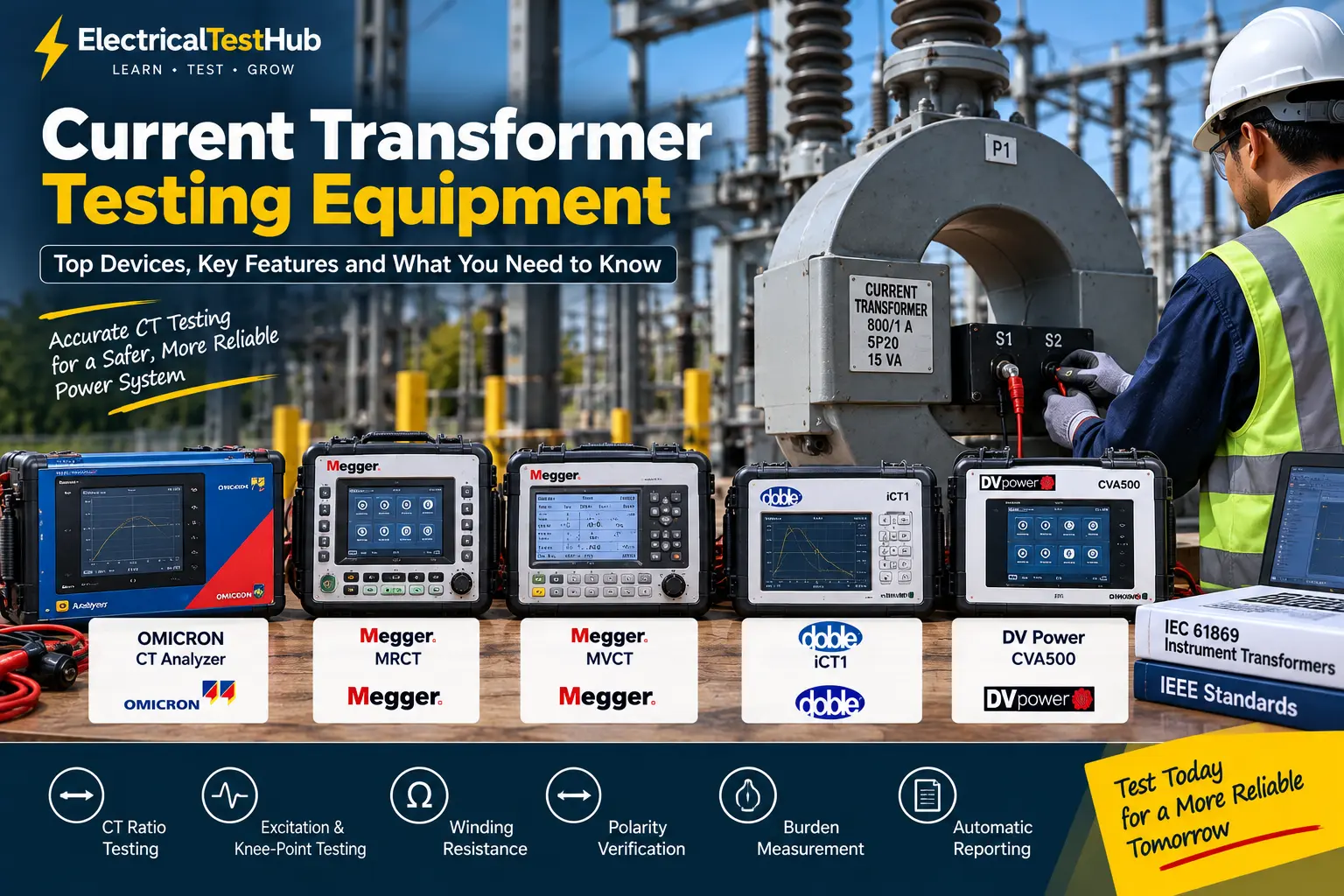
Current transformers (CTs) are essential components in electrical substations and power systems. They provide scaled-down current signals to protection relays, energy meters, measuring instruments and control systems.
Because a CT is directly involved in protection and measurement, its condition and accuracy are extremely important. A CT with an incorrect ratio, polarity problem, excessive winding resistance, incorrect burden, or premature saturation can cause incorrect measurements or even affect protection-system operation.
For this reason, specialized current transformer testing equipment is used during manufacturing, commissioning, maintenance and troubleshooting.
Modern CT test sets can perform several tests automatically, including:
- CT ratio testing
- Polarity verification
- Excitation or saturation testing
- Knee-point voltage measurement
- Winding resistance measurement
- Burden measurement
- Phase-error measurement
- Accuracy evaluation
- Demagnetization
- Insulation resistance testing
- CT nameplate and parameter verification
Different manufacturers provide different types of instruments. Some are dedicated CT analyzers, while others are multifunctional systems that can also test VTs, relays and other substation equipment.
This guide explains the major CT testing devices used in the field and what each type of instrument is designed to do.
What Is Current Transformer Testing Equipment?
Current transformer testing equipment is specialized electrical test equipment used to verify the electrical and performance characteristics of a CT.
Unlike a normal multimeter, a dedicated CT analyzer can apply controlled test signals and analyze the CT’s response.
Depending on the instrument, it may determine:
- Transformation ratio
- Phase error
- Polarity
- Excitation characteristics
- Knee-point voltage
- Winding resistance
- Secondary burden
- Accuracy class
- ALF or FS parameters
- Remanence
- Demagnetization condition
The main advantage is that many of these measurements can be performed automatically and the results can be stored in a test report.
For beginners, it is useful to remember:
A CT tester is not simply a current-measuring instrument. It is a diagnostic system designed to evaluate the performance of the current transformer.
Why Do We Need Dedicated CT Testing Equipment?
A CT may look like a relatively simple device, but its performance depends on several parameters.
For example, consider a protection CT marked:
800/1 A, 5P20, 15 VA
A technician may need to verify:
- Is the CT ratio correct?
- Is the polarity correct?
- Is the secondary winding resistance acceptable?
- Is the excitation curve correct?
- Is the knee-point voltage sufficient?
- Is the actual burden within the CT rating?
- Is the CT suitable for the connected protection system?
A normal multimeter cannot answer all these questions.
A dedicated CT analyzer can perform many of these measurements using one test setup.
Main Types of CT Testing Equipment
CT testing equipment can generally be divided into several groups.
| Equipment Type | Main Purpose |
|---|---|
| CT Analyzer | Complete CT performance analysis |
| CT Ratio Tester | Ratio and polarity testing |
| CT Excitation Tester | Saturation and knee-point testing |
| Winding Resistance Tester | CT secondary winding resistance |
| Burden Tester | Measurement of connected burden |
| Primary Injection Tester | Complete primary-side CT circuit testing |
| Multifunction Test Set | CT + VT + relay + other substation tests |
| Insulation Tester | Insulation resistance testing |
Modern instruments often combine several of these functions into one portable test system.
OMICRON CT Analyzer
OMICRON CT Analyzer official product page
OMICRON’s CT Analyzer is one of the well-known dedicated instruments for current transformer testing.
It is designed specifically for CT testing and can automatically analyze many important CT characteristics.
The instrument applies a low-level test signal to the CT secondary and determines important CT parameters without requiring the technician to energize the CT primary with high current.
Main Tests
OMICRON CT Analyzer can be used for:
- Ratio and phase accuracy
- Winding resistance
- Excitation characteristics
- Knee-point testing
- Composite error
- Burden impedance
- Transient CT parameters
- Remanence
- CT class and ratio verification
- Demagnetization
It can also evaluate the CT according to selected standards.
One useful feature is its ability to identify missing or unknown CT parameters in certain situations.
Why Technicians Like This Type of Instrument
A dedicated CT analyzer is useful when the technician needs a complete CT diagnostic rather than only a simple ratio measurement.
It is particularly useful during:
- CT commissioning
- Protection-system commissioning
- Substation maintenance
- CT troubleshooting
- Factory testing
- Periodic diagnostic testing
OMICRON states that the CT Analyzer uses a maximum test voltage of 120 V and can perform automatic testing with very short test times.
Megger MRCT
Megger MRCT official product page
The Megger MRCT is a portable relay and current transformer test set.
It is designed primarily for CT testing but can also be configured for VT and single-phase relay testing.
This makes it useful for technicians who want more than a dedicated CT analyzer.
Main CT Tests
The MRCT can perform:
- CT ratio testing
- Polarity testing
- Phase deviation
- Excitation testing
- Knee-point testing
- Winding resistance
- Demagnetization
- Insulation testing
- Saturation testing
One important feature is automated testing of multi-ratio CTs.
The instrument can connect to multiple CT taps and perform several tests without repeatedly changing the test leads.
Why This Is Useful
Imagine a CT with five secondary taps.
Without an automated test system, the technician may need to repeatedly:
- Stop the test
- Disconnect leads
- Move to another tap
- Reconnect the leads
- Start the test again
A multifunction CT tester can reduce this repetitive work.
This saves time and reduces the possibility of wiring mistakes.
Megger MVCT
The Megger MVCT is another instrument designed for current and voltage transformer testing.
It can test both CTs and VTs.
According to Megger, the instrument can perform:
- Saturation testing
- Ratio testing
- Polarity testing
- Winding resistance
- Insulation testing
- Burden testing
It also supports testing of multi-ratio CTs.
One notable capability is its high knee-point testing range for suitable CT applications.
This makes the instrument useful for protection CT testing where saturation characteristics are important.
Doble iCT1
Doble iCT1 official product page
The Doble iCT1 is a portable CT/VT test set designed for testing current transformers, voltage transformers and combined transformers.
It is intended to simplify the testing process by allowing several CT tests to be completed from a single connection.
Main CT Tests
The iCT1 can perform:
- Ratio testing
- Polarity testing
- Excitation testing
- Knee-point testing
- Winding resistance
- Burden testing
- Accuracy testing
- ALF/ISF evaluation
- Demagnetization
It also includes a CT Explorer function for identifying CT nameplate-related parameters.
High Knee-Point Testing
Protection CTs can have relatively high saturation or knee-point voltages.
The Doble iCT1 uses a DC-based method for suitable applications and can test CTs with high saturation voltage requirements.
This is especially useful when dealing with protection-class CTs.
Doble T 2000
The Doble T 2000 is another multifunction test system that can be used for CT testing.
It can perform:
- CT ratio
- CT polarity
- CT excitation
- CT knee voltage
- CT winding resistance
- Secondary burden
- Primary injection testing
It can also be used for other transformer and substation testing applications.
One advantage of a multifunction system is that the same test equipment can potentially be used for several commissioning activities instead of purchasing separate instruments for every test.
DV Power CVA500 Series
DV Power Current and Voltage Transformer Analyzer
DV Power’s CVA series is specifically designed for current and voltage transformer testing.
The equipment can perform several important CT tests from a single test setup.
Main CT Tests
The CVA series can perform:
- Turns ratio
- Saturation / knee-point
- Burden
- Demagnetization
- Winding resistance
- Insulation resistance
The instrument can connect to multiple CT secondary taps and use an internal relay matrix to perform measurements across the taps without manually reconnecting the test leads.
High Test Voltage
Depending on the model, the CVA series can provide up to:
- 2 kV AC for saturation testing
- 1 kV DC for insulation resistance testing
This makes it suitable for comprehensive instrument-transformer testing.
DV Power TRT Series
Although the TRT Standard series is primarily a transformer turns-ratio tester, it can also be useful for certain CT ratio verification applications.
Some models can provide low AC test voltage, which allows ratio verification of current transformers.
This type of instrument is useful when the requirement is mainly ratio measurement rather than complete CT characterization.
However, if you need knee-point, excitation, burden and other CT parameters, a dedicated CT analyzer is normally more appropriate.
CT Primary Injection Test Equipment
Not every CT test is performed from the secondary side.
Sometimes the technician needs to verify the complete CT installation, including the primary conductor, CT, secondary wiring and connected equipment.
This is where primary injection testing equipment becomes important.
A primary injection system sends a controlled current through the actual primary circuit.
The technician can then verify:
- CT primary circuit
- CT ratio
- CT secondary current
- Polarity
- Protection relay input
- Metering circuit
- Wiring
- Trip circuit response
Primary injection is therefore different from a simple secondary CT analyzer.
Example
Suppose a 400/5 A CT is installed in a switchgear panel.
A CT analyzer may verify the CT itself from the secondary side.
But if you want to confirm that:
Primary conductor → CT → terminal block → relay → protection circuit
is correctly connected, primary injection can provide a more complete installation-level verification.
CT Ratio Tester vs CT Analyzer
These two terms are sometimes used interchangeably, but they are not necessarily the same.
| Feature | CT Ratio Tester | CT Analyzer |
|---|---|---|
| Ratio | ✓ | ✓ |
| Polarity | ✓ | ✓ |
| Phase error | Sometimes | ✓ |
| Winding resistance | Sometimes | ✓ |
| Excitation curve | Usually limited | ✓ |
| Knee point | Limited | ✓ |
| Burden | Limited | ✓ |
| Remanence | Usually no | ✓ |
| Demagnetization | Sometimes | ✓ |
| Automatic report | Depends on model | Usually |
| Complete CT assessment | Limited | ✓ |
If your requirement is only ratio and polarity, a simple ratio tester may be enough.
If you need a complete protection CT assessment, a dedicated analyzer is much more appropriate.
CT Excitation and Knee-Point Testing Equipment
One of the most important tests for a protection CT is the excitation test.
The test helps determine the CT’s magnetic behavior and identify its knee-point voltage.
A CT can become saturated when the magnetic core reaches a condition where increasing voltage produces a much smaller increase in magnetic flux.
When a protection CT saturates excessively during a fault, the secondary current may no longer accurately represent the primary current.
This can affect protection performance.
Therefore, dedicated CT test sets normally provide an excitation or saturation test function.
The result is often displayed as an excitation curve.
A technician may see:
Voltage → Current
and identify the knee-point region from the curve.
CT Winding Resistance Test Equipment
Winding resistance is another important CT measurement.
The CT secondary winding has a small resistance, so a dedicated low-resistance ohmmeter is normally preferred over a basic multimeter when accurate measurements are required.
A CT analyzer can often perform this test automatically.
The measurement can help identify:
- Loose connections
- Poor joints
- Winding problems
- Incorrect connections
- Abnormal resistance between phases or taps
The result should always be evaluated against appropriate manufacturer data, previous test results and applicable requirements rather than using one universal pass/fail number.
CT Burden Testing Equipment
Burden is the load connected to the CT secondary circuit.
It may include:
- Protection relay input
- Meter input
- Connecting cables
- Terminal blocks
- Test switches
- Other connected devices
For example:
CT → Terminal Block → Cable → Protection Relay
All of these components contribute to the secondary burden.
A CT test system can measure or help evaluate this burden.
This is important because excessive burden can affect CT performance and may contribute to inaccurate transformation or earlier saturation.
CT Demagnetization Equipment
A CT core can retain residual magnetism after certain tests or fault conditions.
This is known as remanence or residual magnetism.
Residual magnetism can affect subsequent CT measurements and may influence the excitation characteristics.
For this reason, many modern CT analyzers include an automatic demagnetization function.
The instrument applies a controlled sequence to reduce residual magnetism in the CT core.
This is especially useful after excitation or saturation testing.
Multifunction vs Dedicated CT Testing Equipment
Which type should you buy?
It depends on your work.
Dedicated CT Analyzer
Best when your main work is:
- CT commissioning
- CT calibration
- Protection CT testing
- CT diagnostics
- Instrument transformer testing
Multifunction Test System
Better when your work includes:
- CT testing
- VT testing
- Relay testing
- Primary injection
- Substation commissioning
- Other electrical tests
| Requirement | Dedicated CT Analyzer | Multifunction System |
|---|---|---|
| CT ratio | Excellent | Excellent |
| CT excitation | Excellent | Excellent |
| CT burden | Excellent | Good/Excellent |
| CT demagnetization | Usually | Usually |
| VT testing | Some models | Usually |
| Relay testing | Limited | Often available |
| Primary injection | Usually no | Some systems |
| Portability | Excellent | Good |
| One instrument for many jobs | Limited | Excellent |
What Should a Beginner Look for When Choosing a CT Tester?
If you are new to CT testing, do not choose equipment only by looking at the maximum current or voltage.
Consider the complete application.
1. CT Type
First determine whether you are testing:
- Metering CT
- Protection CT
- Multi-ratio CT
- Ring-type CT
- Bar-type CT
- Bushing CT
- Special transient CT
2. Required Tests
Make a list of the tests you actually perform.
For example:
Basic requirement
- Ratio
- Polarity
- Winding resistance
Protection CT requirement
- Ratio
- Polarity
- Winding resistance
- Excitation
- Knee point
- Burden
- Demagnetization
3. Maximum Test Voltage
Check the required excitation/knee-point range.
Some protection CTs require considerably higher test voltages than ordinary metering CT applications.
4. Number of CT Taps
If you regularly test multi-ratio CTs, choose a system that can handle multiple taps efficiently.
5. Automatic Reporting
Automatic reports are very useful for professional testing companies.
The report should ideally contain:
- Equipment identification
- CT nameplate information
- Test configuration
- Test results
- Curves
- Pass/fail or evaluation information
- Date and time
- Technician information
6. Portability
Field testing often means carrying equipment into substations.
A lightweight, rugged test set can be a major advantage.
7. Calibration and Support
Before purchasing expensive test equipment, check:
- Calibration availability
- Local technical support
- Spare parts
- Software support
- Manufacturer documentation
- Training availability
Comparison of Popular CT Testing Equipment
| Manufacturer | Equipment | Main Application |
|---|---|---|
| OMICRON | CT Analyzer | Complete CT analysis |
| Megger | MRCT | CT and relay testing |
| Megger | MVCT | CT/VT testing |
| Doble | iCT1 | CT/VT testing |
| Doble | T 2000 | CT and multifunction testing |
| DV Power | CVA Series | CT/VT analysis |
| DV Power | TRT Series | Ratio testing and transformer applications |
The exact capabilities depend on the model and configuration, so technicians should always check the manufacturer’s current specifications before selecting equipment.
Can a Multimeter Be Used for CT Testing?
A multimeter can be useful during CT work, but it should not be considered a complete CT testing instrument.
A multimeter may help check:
- Continuity
- Basic resistance
- Wiring
- Auxiliary circuits
- Terminal connections
But it normally cannot provide a complete assessment of:
- CT ratio
- Excitation curve
- Knee point
- Accuracy class
- CT burden
- Protection CT performance
For professional CT commissioning and diagnostic work, a dedicated CT analyzer or suitable multifunction test system is therefore much more appropriate.
Standards and CT Testing
CT testing should be performed according to the applicable standard, manufacturer instructions and project requirements.
Important standards in the instrument-transformer field include the IEC 61869 series, which covers instrument transformers.
For example, IEC 61869-2 specifically addresses additional requirements for current transformers.
The selected test instrument should therefore support the relevant CT classes and evaluation methods required by the project.
Always check the latest applicable edition of the standard and the manufacturer’s test procedure before conducting the test.
Practical Example: Testing a 400/5 A Protection CT
Suppose you are commissioning a 400/5 A protection CT.
A practical test sequence could include:
Step 1 — Visual Inspection
Check:
- CT nameplate
- Terminal markings
- Earthing
- Secondary connections
- Physical condition
Step 2 — Winding Resistance
Measure the CT secondary winding resistance.
Compare the result with:
- Manufacturer data
- Previous test results
- Other equivalent CTs
Step 3 — Ratio Test
Verify that the CT produces the expected secondary relationship.
For a nominal 400/5 A CT:
400 / 5 = 80:1
The actual measured ratio should be evaluated against the CT’s specified accuracy.
Step 4 — Polarity Test
Confirm that the polarity markings and actual CT polarity are correct.
Step 5 — Excitation Test
Perform the excitation test and obtain the excitation curve.
Check the knee-point characteristics against the CT specification and protection requirements.
Step 6 — Burden Test
Verify that the connected secondary burden is within the CT’s rated capability.
Step 7 — Demagnetization
If required after excitation testing, perform demagnetization.
Step 8 — Report
Save the complete test results and attach the test report to the commissioning documentation.
This entire sequence can be performed efficiently using a modern CT analyzer.
Final Thoughts
Current transformers are small components compared with large power transformers and switchgear, but their performance is extremely important for protection and measurement systems.
Modern current transformer testing equipment makes it possible to evaluate a CT much more thoroughly than with conventional electrical measuring instruments.
Popular manufacturers such as:
- OMICRON
- Megger
- Doble
- DV Power
offer dedicated and multifunctional instruments for CT testing.
The right equipment depends on the application.
If you only need ratio and polarity testing, a simple instrument may be sufficient.
If you are performing protection CT commissioning, you should consider equipment capable of:
Ratio + Polarity + Winding Resistance + Excitation + Knee Point + Burden + Demagnetization + Automatic Reporting.
For larger substation commissioning projects, a multifunction system that combines CT, VT, relay and primary-injection testing may provide better overall value.
Most importantly, never judge a CT test result by the number alone. Always compare the result with the CT nameplate, manufacturer’s specifications, previous test results, applicable standards and the actual protection-system requirements.
The testing instrument provides the measurement. The engineer must determine what that measurement means.
Frequently Asked Questions
What is the best equipment for CT testing?
There is no single best CT tester for every application. OMICRON CT Analyzer, Megger MRCT/MVCT, Doble iCT1 and DV Power CVA series are examples of dedicated or multifunctional CT testing equipment.
Can CT ratio and knee point be tested with the same instrument?
Yes. Many modern CT analyzers can perform both ratio and excitation/knee-point testing.
What equipment is used for CT winding resistance?
A dedicated CT analyzer or low-resistance winding resistance tester can be used, depending on the required test method and accuracy.
Why is CT demagnetization required?
CT testing, especially excitation testing, can leave residual magnetism in the core. Demagnetization helps reduce this residual magnetism before returning the CT to service.
Can the same tester be used for CT and VT testing?
Yes. Many modern instruments are designed for both current and voltage transformer testing. For example, Megger MVCT, Doble iCT1 and DV Power CVA equipment support CT/VT applications.
Is a CT analyzer the same as a primary injection test set?
No. A CT analyzer generally evaluates the CT from its secondary side using controlled test signals. A primary injection system injects current through the actual primary circuit and can verify the complete installed current path.
Which CT tests are most important?
For a typical protection CT, important tests include ratio, polarity, winding resistance, excitation/knee point, burden and demagnetization. The exact test requirements depend on the CT type, application and project specification.
