

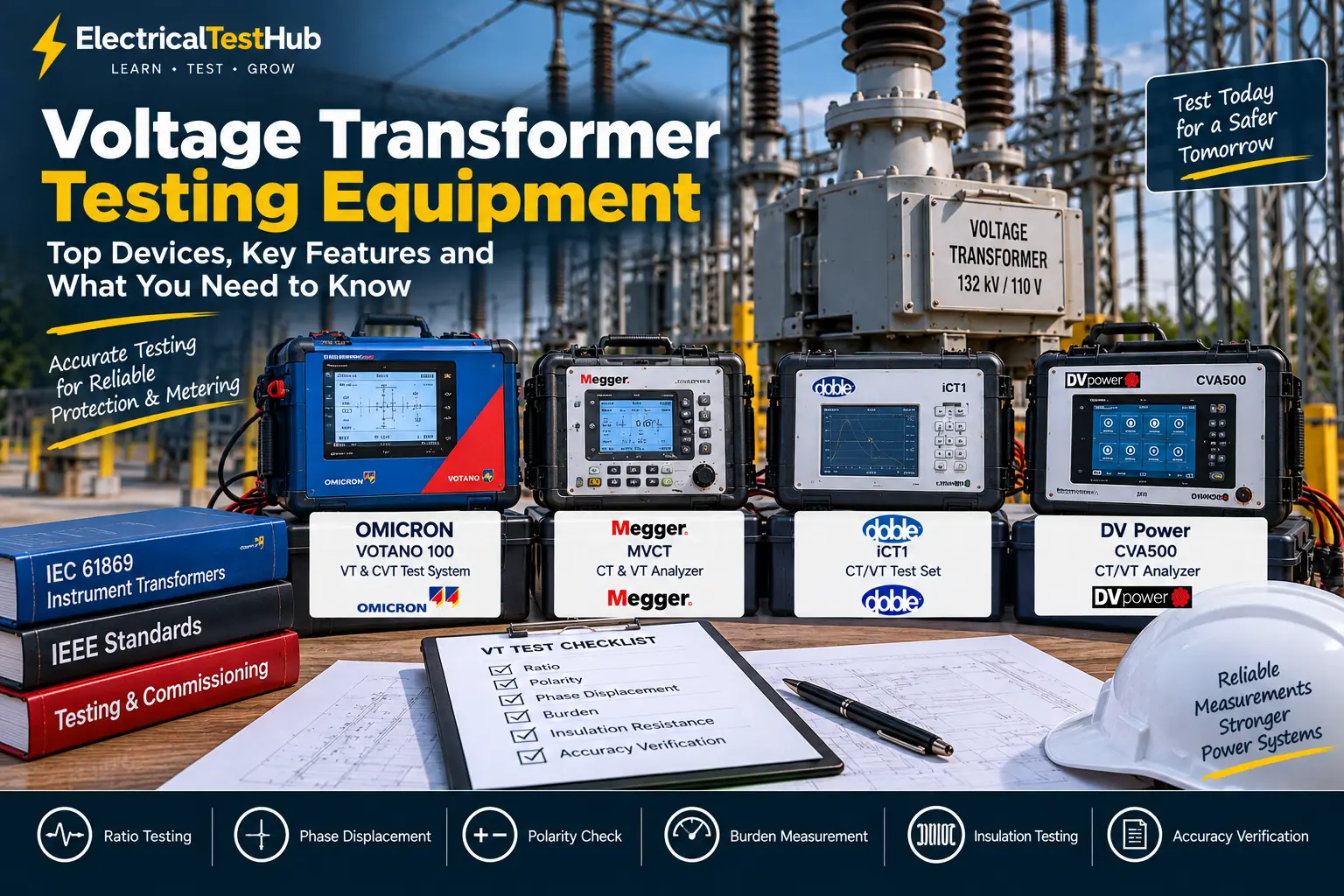
Voltage transformers (VTs), also called potential transformers (PTs), are important components in electrical substations and power systems.
They reduce high system voltage to a lower, measurable voltage that can safely be used by:
- Protection relays
- Energy meters
- Measuring instruments
- Control systems
- Supervisory systems
- Power-quality equipment
For example, a VT may have a primary voltage of 132 kV and a secondary voltage of 110 V.
The protection relay or meter does not directly measure 132 kV. Instead, it receives the reduced voltage from the VT.
Because the VT is part of the measurement and protection chain, incorrect VT ratio, polarity, phase error, burden, insulation condition or secondary wiring can lead to incorrect measurements or protection problems.
This is why specialized voltage transformer testing equipment is used during commissioning, maintenance, calibration and troubleshooting.
Modern VT test systems can perform tests such as:
- Voltage ratio
- Ratio error
- Polarity
- Phase displacement
- Accuracy/class verification
- Burden
- Winding resistance
- Insulation resistance
- No-load current
- Excitation-related measurements
- CVT-specific measurements
This article focuses specifically on VT/PT testing tools and equipment, including popular solutions from OMICRON, Megger, Doble, DV Power and other manufacturers.
What Is Voltage Transformer Testing Equipment?
Voltage transformer testing equipment is specialized test equipment used to verify the electrical performance and condition of a VT or PT.
A normal multimeter can measure voltage, continuity and resistance, but it cannot provide a complete assessment of a high-voltage instrument transformer.
A dedicated VT test system can apply controlled test voltages and measure the VT’s response.
Depending on the instrument, it can determine:
- Actual transformation ratio
- Ratio error
- Phase displacement
- Polarity
- Secondary burden
- Winding resistance
- Accuracy class
- Insulation resistance
- No-load current
- CVT parameters
Some advanced instruments can automatically compare the measured values with selected IEC or IEEE requirements and generate a test report.
For beginners, remember:
A VT tester is not simply a high-voltage voltmeter. It is a diagnostic system used to evaluate the performance of the voltage transformer.
Why Do We Need Dedicated VT Testing Equipment?
Consider a VT with the following nameplate:
132,000 / 110 V
Its nominal transformation ratio is:
132,000 / 110 = 1200:1
During commissioning, simply measuring 110 V on the secondary does not prove that the VT is operating correctly.
A proper test may need to verify:
- Is the ratio correct?
- Is the polarity correct?
- Is the phase displacement within the specified limit?
- Is the secondary burden acceptable?
- Is the accuracy class correct?
- Is the insulation condition satisfactory?
- Are the secondary connections correct?
A dedicated VT test set can perform several of these measurements in a controlled and automated manner.
For a beginner’s overview of the wider testing field, see our guide on Types of Electrical Testing.
Main Types of VT Testing Equipment
VT testing equipment can be divided into several categories.
| Equipment Type | Main Purpose |
|---|---|
| VT Analyzer | Complete VT performance assessment |
| VT Ratio Tester | Ratio verification |
| Multifunction Instrument Transformer Tester | VT + CT testing |
| Primary/High-Voltage Test Set | High-voltage VT testing |
| Burden Tester | Secondary burden measurement |
| Insulation Resistance Tester | Insulation resistance |
| Tan Delta / Power Factor System | Insulation diagnostic testing |
| CVT Analyzer | Testing capacitive voltage transformers |
Modern instruments often combine several functions into one portable system.
OMICRON VOTANO 100
OMICRON VOTANO 100 is one of the best-known dedicated voltage transformer testing systems.
It is designed specifically for testing and calibration of:
- Inductive voltage transformers
- Capacitive voltage transformers
- Protection VTs
- Metering VTs
- CVTs
The VOTANO 100 is a portable system designed for VT testing, class verification and calibration.
Main Tests
VOTANO 100 can be used for:
- Ratio testing
- Ratio error
- Phase displacement
- Polarity
- Burden
- Accuracy class verification
- CVT-related measurements
- VT condition assessment
It can evaluate VT/CVT performance according to selected standards.
How It Works
The system uses controlled test signals and a model-based measurement method.
The test system determines the VT’s equivalent parameters and uses them to assess performance under different operating conditions.
One important advantage is its ability to evaluate VT accuracy under different operating conditions and burdens.
Why It Is Useful
VOTANO 100 is particularly useful for:
- Substation commissioning
- VT calibration
- Metering VT testing
- Protection VT testing
- Periodic maintenance
- Laboratory testing
- Troubleshooting
For the manufacturer’s complete specifications and current capabilities, see the OMICRON VOTANO 100 official product information.
OMICRON VOTANO 100 for CVT Testing
Capacitive voltage transformers are more complicated than conventional inductive VTs.
A CVT contains capacitive components and an electromagnetic transformer section.
Therefore, a conventional VT ratio test alone may not provide enough information about the complete CVT.
VOTANO 100 supports testing of both inductive VTs and CVTs.
It can also be used for CVT-specific measurements and accuracy evaluation.
This makes the instrument particularly useful in high-voltage transmission substations where CVTs are commonly installed.
Megger MVCT
Megger MVCT is a portable analyzer designed to test both current transformers and voltage transformers.
This makes it useful for testing companies that work with both CTs and VTs.
VT Testing Capabilities
For voltage transformers, the instrument can be used for:
- Ratio testing
- Polarity testing
- Winding resistance
- Insulation testing
- Burden testing
For CTs, it also provides functions such as saturation testing.
Why a Combined CT/VT Tester Is Useful
If a commissioning team regularly tests both CTs and VTs, purchasing separate instruments may not always be necessary.
One multifunction instrument can reduce:
- Equipment quantity
- Transport requirements
- Training requirements
- Setup time
This can be particularly useful for field-testing companies.
For current specifications and detailed functions, see the Megger MVCT official product information.
Doble iCT1
The Doble iCT1 is a portable test set designed for:
- Current transformers
- Voltage transformers
- Combined transformers
VT Tests
The iCT1 can perform several VT tests, including:
- Ratio
- Ratio error
- Phase displacement
- Polarity
- Burden
- No-load current
The ratio test applies controlled voltage to the VT primary and measures the resulting secondary voltage.
The instrument can then calculate:
- Actual ratio
- Ratio error
- Phase shift
- Polarity
Burden Testing
The instrument can also measure the VT secondary burden.
This is important because the VT accuracy specification is related to the connected secondary load.
The burden may include:
VT → Terminal Block → Cable → Relay/Meter
All of these components contribute to the load seen by the VT.
Doble STS 4000
The Doble STS 4000 is a multifunction test system that can also be used for VT testing.
Depending on the configuration, it can support several substation testing applications.
VT-related functions can include:
- VT ratio
- Polarity
- Ratio error
- Phase shift
- Burden
- Other instrument-transformer measurements
This type of equipment is useful when the testing company performs multiple substation commissioning activities rather than only VT testing.
Doble STS 5000
The Doble STS 5000 is a multifunction substation maintenance and commissioning system.
It can be configured for testing:
- Current transformers
- Voltage transformers
- Power transformers
- Circuit breakers
- Ground systems
- Other substation equipment
The advantage of this type of equipment is flexibility.
Instead of having one instrument for each test, a multifunction system can support several testing applications.
DV Power CVA500
DV Power CVA500 is a current and voltage transformer analyzer.
Although much of the system’s functionality is focused on CT testing, the CVA series also supports voltage-transformer applications.
For VTs and CVTs, it can be used for tests such as:
- Turns ratio
- Burden
- Winding resistance
- Insulation resistance
The system is designed to provide a portable solution for instrument-transformer testing.
Why This Is Useful
For a testing company that works with both CT and VT equipment, a combined instrument-transformer analyzer can be very practical.
VT Ratio Testing Equipment
Ratio testing is one of the most basic and important VT tests.
Suppose a VT is rated:
33,000 / 110 V
The theoretical ratio is:
33,000 / 110 = 300:1
A VT analyzer applies a controlled voltage and measures the corresponding voltage on the other side.
The instrument then determines the actual ratio.
The result may be expressed as:
- Nominal ratio
- Actual ratio
- Ratio error
- Percentage error
A dedicated VT analyzer can perform this calculation automatically.
VT Polarity Testing Equipment
Polarity is extremely important when VTs are connected to protection and metering circuits.
Incorrect polarity can cause:
- Incorrect power measurements
- Incorrect directional protection
- Incorrect phase relationships
- Protection malfunction
- Incorrect metering results
A dedicated VT tester can verify polarity during the ratio test.
The test equipment identifies the phase relationship between the primary and secondary voltage.
The result should then be compared with the VT nameplate markings and system wiring documentation.
VT Phase Displacement Testing
For accurate metering and protection applications, the phase relationship between primary and secondary voltage is important.
A VT does not behave as an ideal transformer.
There can be a small phase displacement between:
Primary voltage → Secondary voltage
A high-accuracy VT analyzer measures this phase displacement.
This is particularly important for:
- Revenue metering
- High-accuracy metering
- Protection applications
- Instrument-transformer calibration
A modern analyzer can display the phase displacement automatically.
VT Accuracy Class Testing
Voltage transformers may have different accuracy classes depending on their application.
For example:
- Metering VT
- Protection VT
- Special protection application
The testing equipment can compare measured ratio and phase errors against the selected standard and accuracy class.
This is one of the major advantages of using a dedicated VT analyzer instead of simply measuring secondary voltage.
VT Burden Testing Equipment
Burden is the load connected to the VT secondary.
It may consist of:
- Protection relay
- Energy meter
- Measuring instrument
- Connecting cable
- Terminal blocks
- Test switches
For example:
VT → Cable → Terminal Block → Protection Relay
The total connected load becomes part of the VT burden.
If the actual burden is significantly different from the rated burden used for the accuracy specification, VT performance may be affected.
A dedicated VT tester can measure parameters such as:
- Voltage
- Current
- VA
- Power factor
- Impedance
- Phase angle
VT Winding Resistance Testing Equipment
VT winding resistance can be measured using a suitable low-resistance test instrument.
A dedicated instrument transformer analyzer may include this function.
The test can help identify:
- Poor connections
- Loose terminals
- Winding problems
- Abnormal resistance
- Tap-related problems
The result should not be judged using one universal resistance value.
Instead, compare the result with:
- Manufacturer data
- Factory test report
- Previous test results
- Equivalent phases
- Applicable project requirements
For more information about why test values must be interpreted rather than simply labelled pass/fail, read our article Understanding Electrical Test Results.
VT Insulation Resistance Testing Equipment
Insulation resistance is another important diagnostic measurement.
A suitable insulation resistance tester can be used to check insulation between:
- Primary winding and ground
- Secondary winding and ground
- Primary and secondary circuits
The test voltage must be selected according to the equipment design, manufacturer instructions and applicable test procedure.
A basic insulation tester may be sufficient for this particular test, but some multifunction instrument-transformer systems can integrate insulation testing into the overall test workflow.
VT No-Load Current Testing
A VT can draw a small current even when the secondary is unloaded.
This is known as no-load or excitation current, depending on the test arrangement.
Abnormal no-load current can indicate possible issues involving:
- Core condition
- Magnetic behavior
- Winding condition
- Internal problems
Some multifunction VT test systems provide a no-load current test.
CVT Testing Equipment
A Capacitive Voltage Transformer (CVT) is different from a conventional inductive VT.
CVTs are widely used in high-voltage transmission systems.
A CVT contains:
- Capacitive voltage-divider section
- Intermediate transformer
- Compensation/reactor components
- Secondary winding
Because of this construction, CVT testing requires more than simply checking the secondary voltage.
Specialized equipment can evaluate:
- Voltage ratio
- Phase displacement
- Polarity
- Capacitive ratio
- Burden
- Condition-related parameters
Specialized VT analyzers such as VOTANO 100 are designed to support both inductive VT and CVT testing.
VT Analyzer vs General High-Voltage Test Set
These two types of equipment should not be confused.
| Feature | VT Analyzer | General HV Test Set |
|---|---|---|
| VT ratio | ✓ | Depends |
| Ratio error | ✓ | Usually no |
| Phase displacement | ✓ | Usually no |
| Polarity | ✓ | Depends |
| Accuracy class | ✓ | Usually no |
| Burden | ✓ | Usually no |
| Winding resistance | Some models | Usually no |
| Insulation testing | Some models | ✓ |
| High-voltage withstand | Some systems | ✓ |
| Automatic VT evaluation | ✓ | Usually no |
A high-voltage test set can generate test voltage, but it does not automatically mean that it is a complete VT analyzer.
VT Analyzer vs Multimeter
A multimeter is useful during electrical testing, but it is not a replacement for a VT analyzer.
A multimeter may be used for:
- Low-voltage measurement
- Continuity
- Basic resistance
- Secondary wiring checks
A VT analyzer can perform much more detailed measurements:
- Ratio
- Ratio error
- Phase displacement
- Polarity
- Burden
- Accuracy class
- No-load current
- Other VT-specific measurements
Therefore:
Use a multimeter for basic electrical checks; use a dedicated VT test system when you need to prove VT performance.
Comparison of Popular VT Testing Equipment
| Manufacturer | Equipment | Main VT Application |
|---|---|---|
| OMICRON | VOTANO 100 | VT/CVT testing, class verification and calibration |
| Megger | MVCT | VT + CT testing |
| Doble | iCT1 | VT/CT/combined transformer testing |
| Doble | STS 4000 | Multifunction VT/substation testing |
| Doble | STS 5000 | Multifunction substation testing |
| DV Power | CVA500 | VT/CVT + CT testing |
The exact capabilities vary by model, accessories and configuration, so always verify the manufacturer’s current technical documentation before selecting equipment.
Which VT Testing Equipment Should You Choose?
The best instrument depends on your work.
If You Mainly Test VTs
A dedicated VT analyzer such as OMICRON VOTANO 100 may be the most suitable type of equipment.
It is designed specifically around VT/CVT testing and accuracy verification.
If You Test Both CTs and VTs
A combined instrument transformer analyzer such as:
- Megger MVCT
- Doble iCT1
- DV Power CVA series
may be more practical.
If You Perform Complete Substation Commissioning
A multifunction system may be more useful.
You may need:
- CT testing
- VT testing
- Relay testing
- Primary injection
- Circuit-breaker testing
- Other commissioning tests
In this case, a multifunction test system can reduce the number of separate instruments required.
What Should a Beginner Check Before Buying a VT Tester?
Do not choose a VT tester only because it has a high test-voltage rating.
Look at the actual tests you need.
1. VT Type
Determine whether you work with:
- Inductive VT
- PT
- CVT
- Metering VT
- Protection VT
- Combined instrument transformer
2. Required Tests
For example:
Basic VT testing
- Ratio
- Polarity
Complete VT testing
- Ratio
- Ratio error
- Phase displacement
- Polarity
- Burden
- Winding resistance
- Insulation resistance
CVT testing
- Ratio
- Phase
- Polarity
- Capacitive ratio
- Burden
- Additional CVT diagnostics as required
3. Accuracy
If you are testing high-accuracy metering VTs, check the accuracy specification of the test instrument itself.
The tester must be accurate enough for the class being evaluated.
4. Test Voltage
Check the required primary and secondary test-voltage ranges.
5. Burden Capability
If burden testing is important for your work, make sure the selected instrument supports the required voltage and current range.
6. Automatic Reporting
A good test system should make it easy to generate reports containing:
- Equipment ID
- VT nameplate information
- Test setup
- Test results
- Ratio error
- Phase displacement
- Burden
- Polarity
- Evaluation
- Date and time
- Technician information
7. Field Portability
Substation testing is often performed outdoors.
Therefore, consider:
- Weight
- Carrying case
- Display readability
- Cable length
- Environmental rating
- Setup time
Practical Example: Testing a 33 kV / 110 V VT
Suppose you have a VT rated:
33,000 / 110 V
The nominal ratio is:
33,000 / 110 = 300:1
A practical commissioning sequence could be:
Step 1 — Check the Nameplate
Record:
- Primary voltage
- Secondary voltage
- Ratio
- Accuracy class
- Rated burden
- Frequency
- Connection arrangement
Step 2 — Visual Inspection
Check:
- Physical condition
- Earthing
- Terminal markings
- Secondary wiring
- Fuses
- Test links
- Cable condition
Step 3 — Insulation Resistance
Perform the appropriate insulation-resistance measurements.
Step 4 — Winding Resistance
Measure the applicable winding resistance and compare it with expected values.
Step 5 — Ratio Test
Verify the actual transformation ratio.
The nominal ratio should be:
300:1
The measured ratio error should then be evaluated according to the specified accuracy class.
Step 6 — Polarity
Verify that the VT polarity matches the nameplate and system wiring.
Step 7 — Phase Displacement
Measure the phase relationship between primary and secondary quantities.
Step 8 — Burden
Measure the actual connected secondary burden.
Step 9 — Accuracy Evaluation
Compare the measured ratio and phase performance with the required VT class.
Step 10 — Report
Save the complete test report for commissioning records.
This process is much more informative than simply measuring whether the VT secondary produces approximately 110 V.
Important Safety Considerations
VT testing involves potentially dangerous voltages.
Before testing:
- Follow the approved switching procedure.
- Isolate the equipment where required.
- Apply the applicable lockout/tagout procedure.
- Verify absence of voltage where appropriate.
- Discharge and ground circuits according to the approved procedure.
- Establish a controlled test area.
- Use the manufacturer’s test connections.
- Follow the test equipment manual.
- Never assume a VT secondary is safe simply because it is low voltage.
During testing, the primary or secondary circuits may become energized by the test equipment even when the normal system supply is disconnected.
Therefore, VT testing should only be performed by appropriately trained and authorized personnel using the correct procedure.
Standards for VT Testing
Voltage transformer testing should be performed according to the applicable standard, manufacturer requirements and project specifications.
The IEC 61869 series is an important family of standards for instrument transformers.
Depending on the application, relevant requirements may cover:
- Voltage transformers
- Capacitive voltage transformers
- Accuracy
- Ratio
- Phase displacement
- Insulation
- Routine and type tests
IEEE/ANSI requirements may also apply, particularly in systems designed around North American standards.
Modern VT analyzers can provide automated evaluation according to selected IEC and IEEE requirements.
Always use the latest applicable edition specified by the project or asset owner.
Final Thoughts
Voltage transformers are critical links between high-voltage power systems and the low-voltage measurement and protection equipment that engineers rely on.
A VT may appear simple, but its performance depends on several parameters.
A proper VT testing system can help verify:
Ratio + Ratio Error + Phase Displacement + Polarity + Burden + Accuracy + Insulation
For dedicated VT and CVT testing, OMICRON VOTANO 100 is a specialized option.
For combined CT and VT testing, instruments such as Megger MVCT, Doble iCT1 and DV Power CVA series can provide a broader testing solution.
The correct instrument depends on the type of VT, required accuracy, testing environment and scope of work.
The most important lesson for beginners is simple:
Do not judge a VT only by its secondary voltage. A proper test evaluates ratio, phase, polarity, burden and accuracy against the actual requirements of the instrument transformer.
A good test instrument gives you reliable measurements. Good engineering comes from correctly interpreting those measurements.
Frequently Asked Questions
What equipment is used for voltage transformer testing?
Dedicated VT analyzers, multifunction instrument-transformer testers, high-voltage test systems, insulation testers and burden-testing equipment can be used depending on the required tests.
What is the best VT tester?
There is no single best tester for every application. OMICRON VOTANO 100 is a dedicated VT/CVT testing system, while Megger MVCT, Doble iCT1 and DV Power CVA systems combine VT testing with CT or other functions.
Can a VT analyzer test a CVT?
Yes. Some specialized VT analyzers are designed for both inductive VTs and capacitive voltage transformers.
What are the most important VT tests?
Common tests include ratio, ratio error, polarity, phase displacement and burden. Depending on the application, winding resistance, insulation resistance, no-load current and CVT-specific tests may also be required.
Can a multimeter test a VT?
A multimeter can perform basic secondary voltage, resistance and continuity checks, but it is not a replacement for a dedicated VT analyzer.
What is the difference between VT and CVT testing?
A conventional VT uses an electromagnetic transformer arrangement, while a CVT includes a capacitive voltage-divider system. CVTs therefore require additional measurements and considerations related to their capacitive components.
Why is VT burden important?
The secondary burden affects VT performance and accuracy. The actual connected load should therefore be checked against the VT’s specified burden and applicable accuracy requirements.
Can the same instrument test CT and VT?
Yes. Several modern instrument-transformer test systems are designed for both CT and VT testing. Examples include Megger MVCT, Doble iCT1 and DV Power CVA series.
