

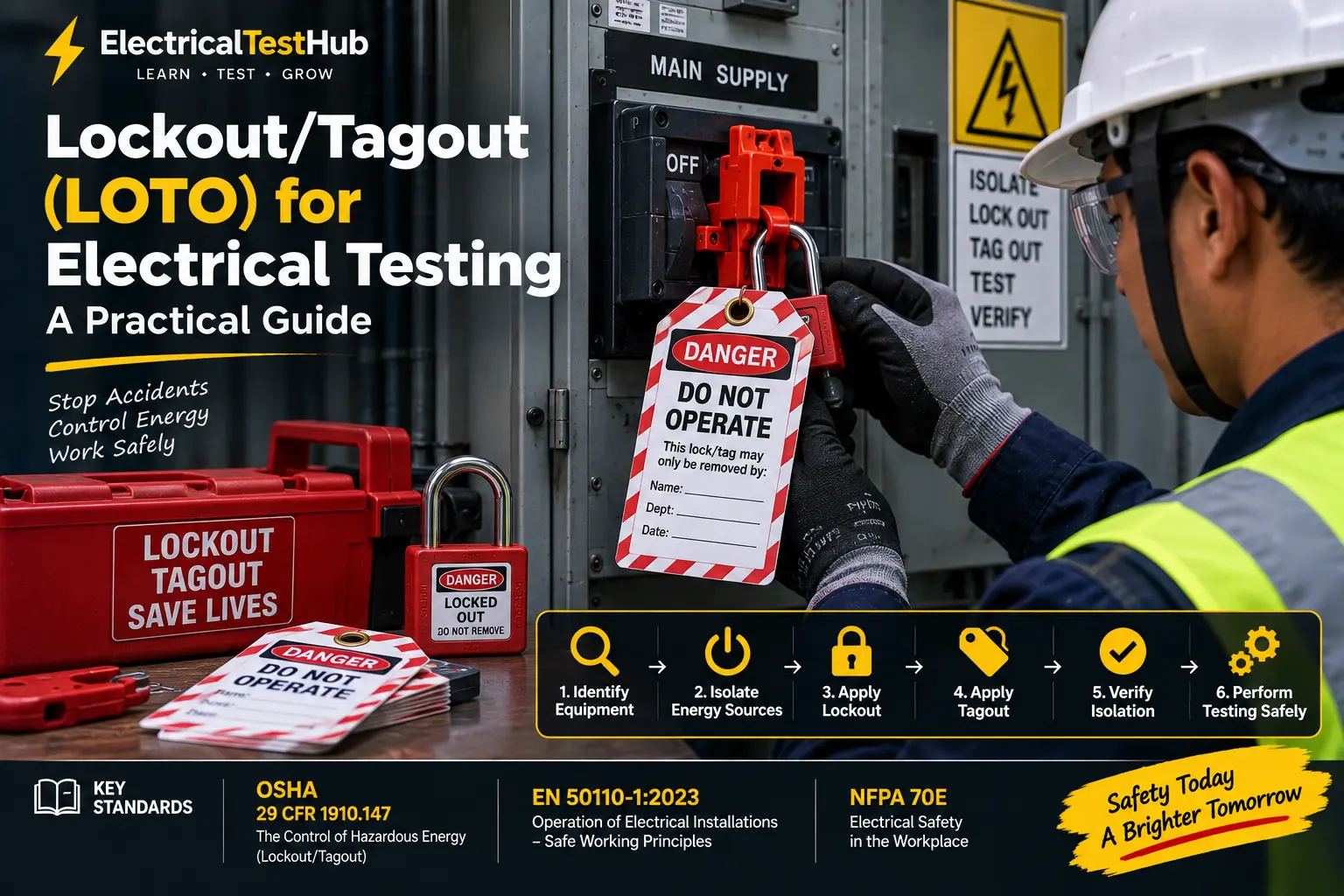
Electrical testing often requires engineers and technicians to work on equipment that has been disconnected from its normal power source.
However, simply switching OFF a circuit breaker does not guarantee that the equipment is safe.
The equipment could be energized accidentally by another person. It may receive power from an alternative source. It may also contain stored electrical energy.
This is why proper Lockout/Tagout (LOTO) procedures are extremely important.
For an electrical testing professional, LOTO is not simply about placing a padlock on a circuit breaker. It is a systematic process for controlling hazardous energy before maintenance, inspection, or testing begins.
In this guide, we will explain LOTO in a simple and practical way, with a focus on real-world electrical testing activities.
Important Safety Notice: Electrical isolation and LOTO must be performed according to the applicable laws, site procedures, equipment manufacturer’s instructions, and authorized workplace safety systems. This article is intended for educational purposes and does not replace formal training or site-specific procedures.
What Is Lockout/Tagout?
Lockout/Tagout, commonly called LOTO, is a safety procedure used to control hazardous energy.
The basic purpose is simple:
Prevent equipment from being unexpectedly energized, started, or operated while people are performing work on it.
LOTO generally involves two important elements.
Lockout
Lockout involves applying a physical locking device to an energy-isolating device.
For example, a padlock may be applied to an isolator or circuit breaker operating mechanism designed for lockout.
The purpose of the lock is to physically prevent unauthorized operation.
Tagout
Tagout involves placing a warning tag on the isolation point.
The tag may communicate important information, such as:
- Do Not Operate
- Do Not Energize
- Name of the authorized person
- Date
- Department or company
- Reason for isolation
A tag provides an important warning, but a tag alone may not provide the same physical restraint as a lock.
For this reason, the applicable workplace procedure and local safety requirements must always be followed.
Why Is LOTO Important During Electrical Testing?
Consider this real-life situation.
An electrical testing team needs to perform an insulation resistance test on a large motor.
The technician performs the following action:
- Opens the motor circuit breaker.
- Walks to the motor.
- Starts connecting an insulation resistance tester.
Meanwhile, another operator sees that the motor has stopped.
The operator assumes that the motor is out of service because of a temporary problem and closes the circuit breaker.
Now the equipment may become energized while the technician is working on it.
This is exactly the type of dangerous situation that a proper energy-control procedure is designed to prevent.
A complete electrical isolation process should address:
- Unexpected energization
- Unexpected equipment startup
- Stored electrical energy
- Alternative energy sources
- Backfeed
- Accidental operation
Important Standards and References for LOTO
Electrical testing professionals should understand the difference between a testing procedure and a safety standard.
The following standards and regulations are commonly relevant to energy control and safe electrical work.
OSHA 29 CFR 1910.147
In the United States, OSHA 29 CFR 1910.147 – The Control of Hazardous Energy (Lockout/Tagout) establishes requirements for controlling hazardous energy during servicing and maintenance activities.
The standard addresses important subjects such as:
- Energy-control programs
- Energy isolation
- Lockout and tagout devices
- Stored energy
- Employee training
- Verification of isolation
- Release from lockout/tagout
- Group lockout/tagout
One important principle is that equipment isolation must be verified before work begins.
EN 50110-1:2023
EN 50110-1:2023 – Operation of Electrical Installations provides requirements and principles for working safely on, with, or near electrical installations.
One of the most important concepts associated with dead working is commonly described as the five safety rules.
The general sequence is:
- Disconnect completely.
- Secure against re-connection.
- Verify the absence of operating voltage.
- Carry out earthing and short-circuiting where required.
- Protect against adjacent live parts.
For electrical testing professionals, these principles provide an excellent framework for understanding how equipment should be made safe before work begins.
NFPA 70E
In locations where NFPA 70E is applicable, electrical safety programs and work practices may also address subjects such as:
- Establishing an electrically safe work condition
- Lockout/tagout
- Verification of absence of voltage
- Electrical hazard assessment
- Shock protection
- Arc flash risk
Always use the edition and requirements adopted by your organization or jurisdiction.
Understanding the LOTO Process for Electrical Testing
The exact procedure depends on the equipment and workplace.
However, a typical electrical testing process can be understood through the following steps.
Step 1: Identify the Equipment
Before isolating anything, clearly identify the equipment that will be tested.
Check:
- Equipment name
- Tag number
- Nameplate
- Panel identification
- Circuit number
- Single-line diagram
- Site drawings
Real-Life Example
Suppose a substation contains two auxiliary transformers:
- Auxiliary Transformer TR-1
- Auxiliary Transformer TR-2
Both transformers may have similar ratings and be located close to each other.
Isolating the wrong transformer can cause an unnecessary outage and may create additional hazards.
Therefore:
Correct equipment identification is the first step of a safe isolation process.
Step 2: Identify All Energy Sources
Do not assume that equipment has only one source of electrical energy.
Before applying LOTO, identify every possible energy source.
These may include:
- Main electrical supply
- Generator supply
- Alternate utility source
- UPS supply
- Battery bank
- DC control supply
- Solar supply
- Capacitor bank
- Backfeed from another circuit
You should also consider stored or residual energy.
For example, a motor may have its main AC supply isolated but still have a control circuit energized from another source.
Similarly, a UPS or battery system may continue supplying DC voltage after the normal AC supply is disconnected.
Step 3: Review the Isolation Procedure
Do not create an isolation procedure based on assumptions.
Before starting work, review:
- Single-line diagrams
- Equipment manuals
- Site operating procedures
- Approved switching procedures
- Permit requirements
- Manufacturer instructions
The goal is to understand exactly how the equipment can be isolated safely.
This is particularly important for:
- Switchgear
- Transformers
- Large motors
- Generators
- Battery systems
- UPS systems
Step 4: Shut Down the Equipment
Before operating an energy-isolating device, the equipment should normally be shut down according to the appropriate operating procedure.
For example, shutting down a motor may involve:
- Stopping the motor through its normal control system.
- Confirming that the motor has stopped.
- Opening the appropriate supply device.
- Isolating all required energy sources.
A proper shutdown helps prevent additional hazards that could occur if equipment is suddenly disconnected while operating.
Step 5: Isolate the Energy Sources
After shutdown, isolate the equipment from all identified energy sources.
Depending on the equipment, this may involve:
- Opening circuit breakers
- Opening disconnectors
- Opening isolators
- Removing fuses
- Disconnecting battery supplies
- Disconnecting control supplies
The important question is not:
“Did I open one breaker?”
The correct question is:
“Have I isolated every energy source that could make this equipment hazardous?”
Step 6: Apply Lockout Devices
Once the appropriate energy-isolating devices have been operated, the applicable lockout device should be applied according to the approved procedure.
The lock helps prevent another person from operating the isolation device.
A personal lock should normally be clearly associated with the authorized person responsible for the work, following the site’s approved system.
The lock should never be treated as decoration.
It represents an important safety barrier between the worker and hazardous energy.
Step 7: Apply a Warning Tag
A warning tag should communicate that the equipment must not be operated.
Depending on the site procedure, the tag may include:
- Name of the authorized person
- Contact information
- Date of application
- Department
- Reason for isolation
- Warning such as “DO NOT OPERATE”
The exact format should follow the organization’s approved LOTO system.
Step 8: Control Stored Energy
One of the most frequently overlooked parts of electrical isolation is stored energy.
Even after the main power supply has been isolated, hazardous energy may remain.
Examples include:
- Capacitors
- Battery banks
- DC systems
- UPS systems
- Power electronic equipment
Stored energy must be safely discharged, disconnected, restrained, or otherwise controlled according to the approved procedure.
Example: Capacitor Bank
A technician opens the incoming circuit breaker of a capacitor bank.
Does this automatically mean that the capacitor terminals are safe to touch?
Not necessarily.
Capacitors can retain electrical charge after disconnection.
The required waiting period, discharge method, and verification procedure should follow the equipment manufacturer’s instructions and approved safety procedures.
Step 9: Verify the Isolation
This is one of the most important steps in the entire process.
Never assume that isolation has been successful. Verify it.
Verification may include confirming the actual electrical condition of the equipment using appropriate methods and properly rated instruments.
The exact procedure depends on the equipment and applicable safety requirements.
For electrical work, simply looking at an open circuit breaker or isolator is not always sufficient.
The actual electrical condition must be appropriately verified before work begins.
This principle is closely connected to our article on Electrical Safety Before Testing: A Complete Pre-Test Safety Checklist.
The Difference Between Isolation and Verification
Beginners sometimes believe that isolation and verification are the same thing.
They are not.
Isolation
Isolation means disconnecting equipment from its energy source.
Example:
You open a circuit breaker and isolator.
Verification
Verification means confirming that the expected safe condition has actually been achieved.
Example:
You follow an approved procedure to verify the electrical condition using properly rated equipment.
Both steps are essential.
Isolation is the action. Verification confirms the result.
The EN 50110-1 Five Safety Rules
For beginners, the five safety rules provide an excellent framework for understanding electrical isolation.
Rule 1: Disconnect Completely
The electrical installation or equipment must be disconnected from the relevant sources of electrical energy.
Rule 2: Secure Against Reconnection
The isolation point must be protected against unauthorized or accidental reconnection.
This is where LOTO can play an important role.
Rule 3: Verify the Absence of Operating Voltage
Do not simply assume that the equipment is dead.
Verify the electrical condition according to the approved procedure.
Rule 4: Earth and Short-Circuit Where Required
For certain electrical systems, particularly where required by the applicable procedure, earthing and short-circuiting may be necessary to protect workers.
This is especially important in situations where induced voltage or unexpected energization could create a hazard.
Rule 5: Protect Against Adjacent Live Parts
Nearby energized components can still present a danger.
Appropriate protective measures may be required to prevent accidental contact with adjacent live equipment.
A Real-Life Example: Preparing a Motor for Testing
Suppose you need to perform an insulation resistance test on a 415 V induction motor.
A simplified work sequence could involve the following.
1. Identify the Correct Motor
Confirm:
- Motor tag number
- Motor nameplate
- Associated MCC feeder
2. Stop the Motor
Use the approved operational procedure to stop the equipment.
3. Identify All Energy Sources
Check for:
- Main AC supply
- Control supply
- VFD connections
- External circuits
4. Isolate the Required Sources
Open the appropriate isolating devices.
5. Apply LOTO
Apply locks and warning tags according to the approved site procedure.
6. Verify the Electrical Condition
Follow the approved absence-of-voltage verification procedure before touching electrical conductors.
7. Prepare the Motor for Testing
Disconnect or isolate components where required by the approved test procedure.
For example, sensitive electronic equipment connected to the motor circuit may require special consideration before an insulation resistance test is performed.
8. Perform the Electrical Test
Carry out the required test using the appropriate instrument and test procedure.
9. Safely Discharge After Testing
Certain electrical tests can introduce or leave electrical charge on equipment.
Follow the test equipment manufacturer’s instructions and approved procedure for discharging the equipment.
10. Restore the Equipment Safely
When testing is complete, remove test equipment, inspect the work area, and follow the approved restoration procedure.
Only authorized personnel should remove LOTO devices according to the organization’s established procedure.
Can Equipment Be Energized Temporarily for Testing?
Sometimes troubleshooting or testing requires equipment to be energized temporarily.
This situation requires special attention.
For example, a machine may need to be energized briefly for:
- Functional testing
- Equipment positioning
- Troubleshooting
The normal LOTO condition may need to be temporarily changed according to an approved procedure.
OSHA 29 CFR 1910.147 specifically addresses situations where energy-control devices must be temporarily removed for testing or positioning.
The general principle is:
- Clear tools and unnecessary materials.
- Ensure people are safely positioned.
- Follow the approved procedure for temporary removal of energy controls.
- Perform the required testing.
- De-energize the equipment again.
- Reapply the required energy-control measures before continuing work.
This should never be treated as an informal shortcut.
Temporary energization must be carefully planned and controlled.
Group Lockout/Tagout
Electrical testing projects may involve multiple people.
For example:
- Testing engineer
- Electrical technician
- Switching operator
- Mechanical technician
- Commissioning engineer
In these situations, a single person’s lock may not provide complete protection for everyone.
A properly designed group LOTO procedure is required when multiple authorized employees are working under the same energy-control system.
Each worker should understand:
- Who controls the isolation
- Which equipment is isolated
- Which work is being performed
- When the equipment can be returned to service
Never assume that another person’s lock automatically provides protection for you.
Follow the organization’s approved group lockout procedure.
Common LOTO Mistakes Made by Beginners
Mistake 1: Locking Only the Main Circuit Breaker
The equipment may have additional energy sources.
Always identify every possible source.
Mistake 2: Using Only a Tag When a Physical Lock Is Required
A warning tag provides information but may not physically prevent operation.
Follow the applicable site procedure.
Mistake 3: Forgetting Stored Energy
Capacitors, batteries, and other systems can remain hazardous after isolation.
Mistake 4: Not Verifying the Electrical Condition
An open breaker does not automatically prove that equipment is electrically safe.
Mistake 5: Removing Someone Else’s Lock
LOTO devices should only be removed according to the organization’s authorized procedures.
Never casually remove another person’s lock.
Mistake 6: Performing Testing Without Understanding the System
Before testing, understand:
- Where the energy comes from
- How the equipment is connected
- What remains energized
- What test voltage will be applied
A Simple LOTO Checklist for Electrical Testing
Before beginning electrical testing, consider the following checklist.
Before Isolation
- I have identified the correct equipment.
- I understand the testing requirement.
- I have identified all energy sources.
- I have reviewed the approved procedure.
During Isolation
- The equipment has been properly shut down.
- All required energy sources have been isolated.
- Lockout devices have been applied where required.
- Warning tags have been applied according to the procedure.
- Stored energy has been controlled.
Before Testing
- The isolation has been verified.
- The electrical condition has been appropriately checked.
- Adjacent live equipment has been considered.
- The correct test equipment has been selected.
- The test area is controlled.
After Testing
- Test equipment has been removed safely.
- Test-induced or stored energy has been addressed.
- The work area has been inspected.
- All personnel are clear of the equipment.
- Equipment restoration follows the approved procedure.
- LOTO devices are removed only by authorized personnel according to the established procedure.
Key Takeaways
Lockout/Tagout is one of the most important safety concepts for electrical testing professionals.
Remember these principles:
- Switching OFF equipment is not always sufficient.
- Identify every possible energy source.
- Follow approved isolation procedures.
- Secure equipment against unexpected reconnection.
- Control stored electrical energy.
- Verify the electrical condition before beginning work.
- Consider adjacent live parts.
- Follow special procedures for group work.
- Never remove LOTO devices without proper authorization.
- Follow a controlled restoration procedure after testing.
The most important lesson is:
LOTO is not a padlock. LOTO is a complete hazardous-energy control process.
A competent electrical testing professional must understand both the testing procedure and the safety process required before the test begins.
What to Learn Next
The next important topic in our Electrical Safety Fundamentals series is:
How to Verify Absence of Voltage Safely
In the next article, we will explain one of the most important safety practices before electrical work:
How do you verify that equipment is actually de-energized?
We will discuss the practical process of using appropriately rated test instruments, checking the instrument before and after verification, identifying possible energy sources, and avoiding common beginner mistakes.
