

One of the most common questions asked by people who are new to electrical testing is:
When should electrical equipment actually be tested?
The simple answer might seem to be:
“Test the equipment regularly.”
However, real-world electrical maintenance is more complicated than that.
Different types of electrical equipment have different operating conditions, levels of importance, maintenance requirements, and risks.
For example, a small non-critical motor in a workshop may not require the same testing approach as a critical transformer in a power plant.
Similarly, a circuit breaker that operates several times every day may require a different maintenance strategy from an emergency circuit breaker that remains unused for long periods but must operate correctly when a fault occurs.
Therefore, there is no single testing schedule that is suitable for every piece of electrical equipment.
The correct timing for electrical testing can depend on several factors, including:
- Equipment type
- Equipment age
- Equipment criticality
- Operating environment
- Manufacturer recommendations
- Maintenance history
- Previous test results
- Applicable standards
- Site maintenance procedures
This article explains the most common situations in which electrical equipment should be tested and provides a practical framework for beginners.
The Simple Answer: Electrical Equipment Is Tested for Different Reasons
Electrical testing is generally performed when there is a specific reason or objective.
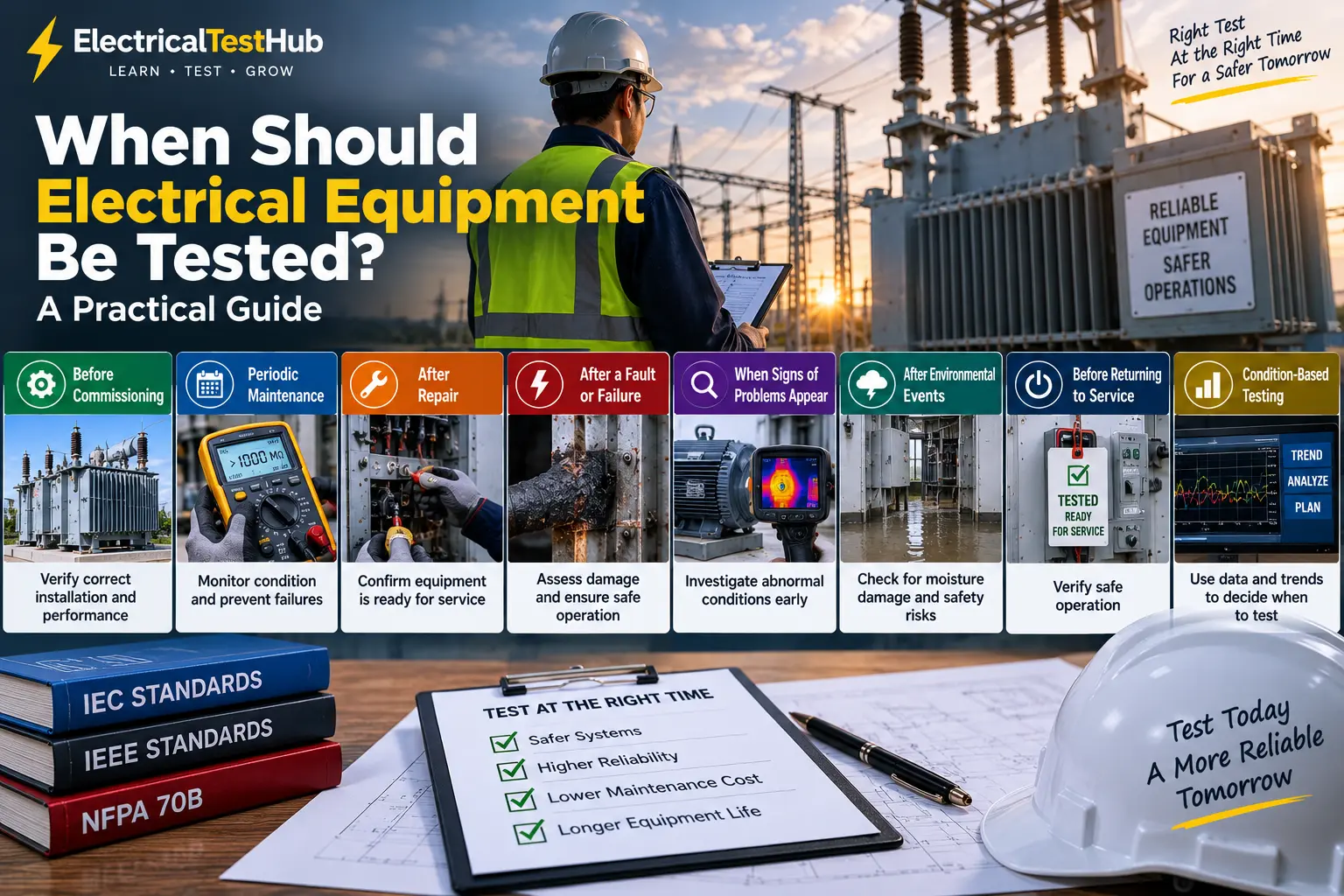
For beginners, the major situations can be divided into the following categories:
- Before equipment is placed into service
- During periodic maintenance
- After repair or modification
- After a fault or abnormal event
- When equipment condition is suspected to be deteriorating
- Before returning equipment to service
- As part of condition-based maintenance
Let’s examine each situation.
1. Testing Before Equipment Is Placed Into Service
One of the most important times to perform electrical testing is before new or newly installed equipment is placed into normal operation.
This process is commonly associated with:
- Pre-commissioning testing
- Commissioning testing
- Acceptance testing
The purpose is to establish confidence that the equipment has been installed correctly and is suitable for its intended operation.
Depending on the equipment, testing may help verify:
- Correct installation
- Electrical connections
- Insulation condition
- Equipment characteristics
- Protective system operation
- Functional performance
Real-Life Example: A New Transformer
Imagine that a new power transformer has been delivered and installed at a substation.
The transformer may look physically perfect.
However, visual appearance alone cannot confirm every aspect of its electrical condition.
Depending on the project requirements and equipment type, commissioning tests may include:
- Insulation resistance testing
- Transformer turns ratio testing
- Winding resistance testing
- Other diagnostic or functional tests
The exact tests should be selected according to the applicable requirements.
New equipment should not automatically be considered ready for service simply because it is new.
Transportation, storage, installation, and connection activities can all potentially affect equipment condition.
2. Testing During Periodic Maintenance
Periodic testing is one of the most common reasons for electrical equipment testing.
Equipment can deteriorate over time because of:
- Normal aging
- Heat
- Moisture
- Contamination
- Mechanical stress
- Electrical stress
- Frequent operation
- Environmental conditions
Periodic testing provides an opportunity to evaluate equipment condition before a serious failure occurs.
For example, a maintenance program may require certain equipment to be tested at scheduled intervals.
The interval may depend on the equipment and its importance.
Example
A facility may periodically test:
- Circuit breakers
- Transformers
- Motors
- Cables
- Protective relays
- Battery systems
However, it is important to understand the following:
Periodic testing does not mean that every electrical device must be tested at the same interval.
A suitable maintenance interval should consider the specific equipment and its operating conditions.
Why a Fixed Testing Interval Is Not Always Enough
Suppose two identical motors are installed at different locations.
Motor A
- Operates in a clean environment
- Runs occasionally
- Is not critical to production
Motor B
- Operates continuously
- Is exposed to high temperatures
- Works in a dusty industrial environment
- Is critical to production
Would it be reasonable to use exactly the same maintenance and testing strategy for both motors?
Possibly not.
Motor B may experience more severe operating conditions and may have a greater consequence if it fails.
This demonstrates an important principle:
Testing frequency should be based on risk and equipment condition, not only on the calendar.
3. Testing After Repair
Electrical equipment may require testing after repair or maintenance work.
The purpose is to help verify that the equipment is suitable for service after the work has been completed.
Examples include:
- Motor rewinding
- Circuit breaker repair
- Transformer maintenance
- Cable repair
- Replacement of electrical components
- Replacement of protective devices
The required tests depend on the type of equipment and the repair that was performed.
Example: Circuit Breaker Repair
Suppose maintenance personnel repair or replace a circuit breaker’s operating mechanism.
Before returning the breaker to normal service, appropriate checks or tests may be required.
Depending on the work performed, these may include:
- Mechanical operation checks
- Timing tests
- Functional tests
- Contact resistance tests
The purpose is to confirm that the repair has not created another problem.
4. Testing After an Electrical Fault or Failure
An electrical fault can cause damage that is not immediately visible.
Therefore, after a significant electrical event, equipment may need to be inspected and tested before being returned to service.
Examples of abnormal events include:
- Short circuits
- Earth faults
- Electrical fires
- Lightning events
- Equipment failures
- Severe overload conditions
Example: Cable Fault
Suppose an underground cable experiences a fault.
The visible part of the cable may appear normal.
However, the fault may have damaged:
- Cable insulation
- Cable joints
- Cable terminations
After repairs, appropriate testing may be required to assess the cable before it is returned to service.
Never assume that equipment is healthy simply because it appears to be operating normally after a fault.
The appropriate investigation and testing process should be determined by qualified personnel.
5. Testing When Equipment Shows Signs of a Problem
Electrical equipment does not always need to wait for a scheduled maintenance date before being investigated.
Sometimes, equipment provides warning signs.
These may include:
- Abnormal noise
- Excessive temperature
- Burning smell
- Frequent tripping
- Unusual vibration
- Unstable electrical readings
- Visible overheating
- Oil leakage
- Unexpected operational problems
When abnormal conditions are identified, additional inspection or testing may be necessary.
Example
Imagine a motor that has operated normally for several years.
Recently, operators have noticed that it occasionally trips.
Waiting until the next scheduled annual test may not be the correct approach.
The equipment may require earlier investigation.
Depending on the situation, technicians may review:
- Supply voltage
- Current
- Insulation condition
- Protective devices
- Mechanical condition
This approach is known as responding to the actual condition of the equipment rather than relying only on a fixed schedule.
6. Testing After Major Environmental Events
Electrical equipment can be affected by environmental conditions.
Testing or inspection may be required after events such as:
- Flooding
- Water ingress
- Fire
- Lightning
- Severe storms
- Excessive contamination
- Physical damage
Example: Water Ingress
Suppose water enters an electrical room because of flooding.
Even after the water has been removed, electrical equipment may have experienced:
- Moisture contamination
- Insulation deterioration
- Corrosion
- Damage to electrical connections
The equipment should not simply be energized without an appropriate assessment.
Inspection and testing may be required to determine whether the equipment can safely return to service.
7. Testing Before Returning Equipment to Service
Some equipment is removed from service for maintenance, repair, storage, or other operational reasons.
Before returning it to service, appropriate verification may be necessary.
This is particularly important for critical equipment.
Examples may include:
- Circuit breakers
- Transformers
- Motors
- Generators
- Protection systems
- Battery systems
The required process may include:
- Visual inspection
- Mechanical inspection
- Electrical testing
- Functional verification
- Review of test results
- Approval for return to service
The exact procedure depends on the equipment and site requirements.
8. Condition-Based Electrical Testing
Traditional maintenance often follows a fixed schedule.
For example:
Test every 12 months.
However, modern maintenance strategies may also consider the actual condition of equipment.
This is generally known as condition-based maintenance.
The basic idea is simple:
Use equipment condition and available data to help determine when maintenance or testing is needed.
For example, an engineer may review:
- Previous test results
- Temperature trends
- Operating history
- Number of equipment operations
- Equipment age
- Environmental conditions
If the available information indicates a developing problem, additional testing may be performed.
A Simple Example of Condition-Based Testing
Imagine that a transformer has been tested several times.
The results are recorded as follows:
| Test Period | Result Trend | Recommended Action |
|---|---|---|
| First Test | Normal | Establish baseline |
| Second Test | Stable | Continue normal monitoring |
| Third Test | Noticeable change | Review and investigate |
| Fourth Test | Further deterioration | Perform additional assessment |
The actual test result and acceptance criteria will depend on the test and equipment.
The important lesson is that the trend may be more important than one individual number.
This is why accurate test reports and historical records are valuable.
9. Testing Critical Equipment More Carefully
Not all electrical equipment has the same importance.
Consider the following two examples.
Equipment A
A small ventilation motor that can be easily replaced.
Equipment B
A critical transformer that supplies an entire industrial facility.
The consequences of failure are very different.
Therefore, the maintenance and testing strategy may also be different.
Critical equipment may require:
- More detailed inspection
- More frequent assessment
- Advanced diagnostic testing
- Continuous or online monitoring
Examples of critical equipment may include:
- Main transformers
- Emergency generators
- Critical circuit breakers
- UPS battery systems
- Protection systems
The appropriate testing strategy should consider:
What happens if this equipment fails?
10. Testing Based on Equipment Age
Electrical equipment can deteriorate as it ages.
However, age alone does not always determine equipment condition.
A well-maintained 20-year-old transformer may be in better condition than a poorly maintained 5-year-old transformer.
Therefore, equipment age should be considered together with:
- Operating conditions
- Maintenance history
- Test results
- Equipment loading
- Environmental exposure
As equipment becomes older, condition assessment and historical test data may become increasingly important.
The Role of Inspection Before Testing
Before deciding that electrical testing is required, an inspection may provide important information.
For example, inspection can identify:
- Physical damage
- Contamination
- Corrosion
- Oil leakage
- Loose components
- Signs of overheating
This information can help determine what additional testing may be required.
To understand the difference between these activities, read our guide:
Electrical Testing vs Electrical Inspection: What Is the Difference?
A professional assessment often follows a logical sequence:
Inspection → Identify Concerns → Select Test → Test Safely → Analyze Results → Take Action
Standards and Manufacturer Recommendations
Electrical testing intervals should not be selected randomly.
Depending on the application, testing requirements may be based on:
- Manufacturer recommendations
- Applicable IEC standards
- IEEE standards
- NFPA requirements
- Local regulations
- Project specifications
- Site maintenance procedures
For low-voltage electrical installations, IEC 60364-6 addresses verification and includes provisions relating to initial and periodic verification.
For electrical equipment maintenance, NFPA 70B provides a structured approach to electrical equipment maintenance and testing.
However, it is important to remember:
A standard must always be applied correctly to the specific equipment and situation.
Do not use a testing interval from one type of equipment as a universal requirement for every electrical asset.
How to Decide When Equipment Should Be Tested
Beginners can use the following simple framework.
Question 1: Is the Equipment New?
If yes, appropriate pre-commissioning or commissioning tests may be required.
Question 2: Is the Equipment Due for Scheduled Maintenance?
Review the maintenance plan and applicable requirements.
Question 3: Has the Equipment Been Repaired?
Appropriate post-repair testing may be required.
Question 4: Has an Electrical Fault Occurred?
The equipment may require inspection and testing before returning to service.
Question 5: Is the Equipment Showing Abnormal Signs?
Do not automatically wait for the next scheduled maintenance date.
Further investigation may be necessary.
Question 6: Have Previous Test Results Changed?
Review the trend and determine whether additional testing is required.
A Practical Testing Decision Flow
A simple electrical testing process can be understood as follows:
Step 1: Identify the Equipment
Understand:
- Equipment type
- Voltage level
- Function
- Importance
Step 2: Review Its History
Check:
- Previous test results
- Maintenance records
- Previous faults
- Repair history
Step 3: Inspect the Equipment
Look for:
- Physical damage
- Contamination
- Leakage
- Signs of overheating
Step 4: Identify the Reason for Testing
Ask:
Why am I testing this equipment today?
The answer might be:
- Commissioning
- Scheduled maintenance
- Troubleshooting
- Post-repair verification
- Condition assessment
Step 5: Select the Appropriate Test
Different tests answer different questions.
For a complete overview of the major testing methods, read:
Types of Electrical Testing: A Beginner’s Complete Overview
Step 6: Perform the Test Safely
Use:
- Appropriate procedures
- Suitable instruments
- Required safety controls
- Qualified personnel
Step 7: Analyze the Results
Consider:
- Manufacturer recommendations
- Applicable standards
- Historical data
- Equipment condition
Step 8: Take Appropriate Action
Depending on the results, the next action may be:
- Continue normal operation
- Monitor the equipment
- Perform additional testing
- Perform maintenance
- Repair the equipment
- Remove equipment from service
Common Mistakes Beginners Make
Mistake 1: Testing Only Because the Calendar Says So
Scheduled testing is important, but actual equipment condition should not be ignored.
Mistake 2: Waiting for Complete Equipment Failure
Electrical testing can help identify some developing problems before complete failure occurs.
Mistake 3: Using the Same Testing Schedule for Every Asset
Different equipment has different risks and operating conditions.
Mistake 4: Ignoring Previous Test Results
Historical data can provide important information about equipment condition.
Mistake 5: Returning Equipment to Service Without Appropriate Verification
Following repair or a major fault, equipment may require inspection and testing before normal operation resumes.
Key Takeaways
Electrical equipment may need to be tested:
- Before commissioning
- During periodic maintenance
- After repair
- After an electrical fault
- After abnormal environmental events
- Before returning equipment to service
- When abnormal operating conditions appear
- When historical data indicates a developing problem
The most important lesson is:
There is no single testing schedule that is correct for every piece of electrical equipment.
A practical testing strategy should consider:
Equipment Type + Equipment Criticality + Operating Environment + Maintenance History + Test Results + Applicable Requirements
For a beginner, always start by asking:
Why does this equipment need to be tested now?
Once you understand the reason for testing, it becomes much easier to select the correct test method and interpret the results.
What to Learn Next
Now that you understand when electrical equipment should be tested, the next important question is:
Understanding Electrical Test Results: What Does Pass or Fail Really Mean?
Many beginners believe that every electrical test result is simply either PASS or FAIL.
In reality, professional electrical testing is often more complicated.
A test result may indicate:
- Normal condition
- A developing problem
- A condition requiring monitoring
- A need for further investigation
- An immediate maintenance concern
In the next article, we will explain how electrical test results should be understood and why a single number does not always tell the complete story.
