

When entering the electrical testing industry, beginners often hear terms such as:
- Electrical inspection
- Electrical testing
- Electrical measurement
- Equipment condition assessment
- Preventive maintenance
These terms are sometimes used interchangeably. However, they do not all mean the same thing.
For example, imagine that you are inspecting an electrical panel.
You may notice:
- A loose connection
- Discoloration
- Dust accumulation
- Corrosion
- A damaged cable
- Missing labels
These conditions may be identified through inspection.
But what if a cable looks perfectly normal from the outside while its insulation has started to deteriorate internally?
A visual inspection may not identify that problem.
In that situation, electrical testing may be required.
This is the fundamental difference:
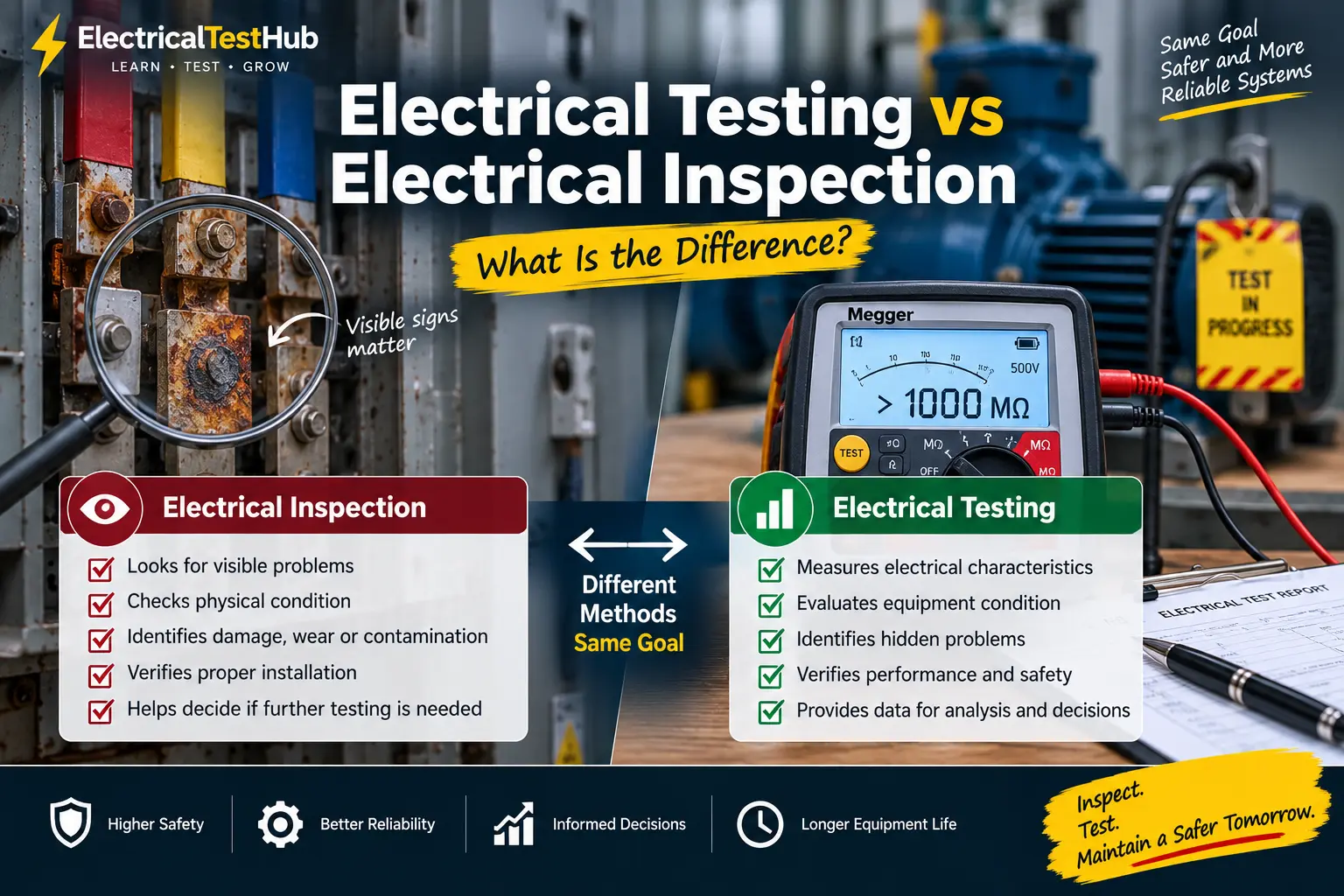
Electrical inspection looks for observable conditions, while electrical testing uses measurements or test methods to evaluate electrical characteristics and equipment condition.
Both are important.
In fact, a complete electrical maintenance or verification program often requires inspection and testing to work together.
For beginners, understanding this difference is an important first step toward becoming a competent electrical testing professional.
The Simple Difference Between Inspection and Testing
The easiest way to understand the difference is to ask two questions.
Electrical Inspection Asks:
What can we observe?
Electrical Testing Asks:
What can we measure or verify?
An inspection may identify visible problems.
A test can provide measurable information about electrical performance or condition.
However, the difference is not always completely separate.
A professional electrical assessment may involve:
Inspection → Measurement → Testing → Analysis → Decision
Each step can provide different information about the equipment.
What Is Electrical Inspection?
Electrical inspection is the systematic examination of electrical equipment or installations to identify visible, physical, mechanical, or observable problems.
An inspection may involve looking, checking, touching only when safely permitted, and examining equipment according to an approved procedure.
Common inspection activities may include checking for:
- Physical damage
- Loose components
- Corrosion
- Overheating signs
- Contamination
- Oil leakage
- Damaged insulation
- Missing covers
- Incorrect labeling
- Abnormal noise
- Mechanical defects
The purpose is to identify conditions that may require additional investigation, maintenance, or testing.
A Real-Life Inspection Example
Imagine that you are inspecting a medium-voltage switchgear panel.
During the inspection, you notice that one of the following conditions is present:
- Dust has accumulated inside the panel.
- A cable termination appears discolored.
- A component has visible corrosion.
- A warning label is missing.
- An abnormal burning smell is present.
These observations can provide important information.
However, the inspection alone may not answer questions such as:
- Is the insulation resistance acceptable?
- Is the circuit breaker operating at the correct speed?
- Is the contact resistance within the expected range?
- Is the protective relay operating correctly?
Additional testing may be required to answer these questions.
What Is Electrical Testing?
Electrical testing involves using a defined test method and appropriate test equipment to measure, verify, or evaluate a specific electrical characteristic.
Depending on the equipment, electrical testing may evaluate:
- Insulation condition
- Electrical continuity
- Contact resistance
- Earth resistance
- Circuit breaker operation
- Transformer characteristics
- Battery capacity
- Protective relay operation
The purpose of a test should always be clear before testing begins.
For example, an insulation resistance test is performed for a different purpose than a circuit breaker timing test.
You can learn more about the different categories of tests in our guide:
Types of Electrical Testing: A Beginner’s Complete Overview
Inspection vs Testing: A Simple Comparison
| Electrical Inspection | Electrical Testing |
|---|---|
| Examines observable conditions | Measures electrical characteristics |
| May identify visible defects | Can identify hidden electrical problems |
| Often performed using visual and physical examination | Requires appropriate test instruments |
| Can identify physical damage | Can evaluate insulation, resistance, timing, and other characteristics |
| May lead to further testing | Produces measurable results for evaluation |
The two methods should not be considered competitors.
Instead:
Inspection and testing are complementary activities.
Where Does Electrical Measurement Fit In?
Electrical measurement is another term that can confuse beginners.
A measurement involves determining the value of an electrical quantity.
Examples include:
- Voltage = 415 V
- Current = 120 A
- Frequency = 50 Hz
- Resistance = 0.5 Ω
Electrical testing may involve one or more measurements.
However, not every measurement should automatically be considered a complete electrical test.
Example
Suppose you use a multimeter to measure the voltage at a motor terminal.
You obtain a result of:
415 V
This is an electrical measurement.
Now suppose you perform a complete insulation resistance test on the motor winding using an insulation resistance tester and follow a defined test procedure.
This is an electrical test.
The difference can be understood as:
A measurement provides a value. A test uses a defined method to evaluate a specific condition or characteristic.
Why Visual Inspection Alone Is Not Enough
Visual inspection is important, but it has limitations.
Many electrical problems are not visible.
Consider the following examples.
Example 1: Internal Cable Insulation Deterioration
A cable may look perfectly normal from the outside.
However, internal insulation deterioration may exist because of:
- Moisture
- Aging
- Thermal stress
- Mechanical damage
Appropriate electrical testing may be required to investigate the cable’s condition.
Example 2: Circuit Breaker Performance
A circuit breaker may look clean and mechanically intact.
However, visual inspection alone cannot always determine:
- Actual opening time
- Closing time
- Pole synchronization
- Contact resistance
Specialized testing may be required.
Example 3: Transformer Internal Condition
A transformer can appear normal externally while developing internal problems.
Different diagnostic tests may provide information about:
- Winding condition
- Insulation condition
- Internal mechanical movement
- Electrical characteristics
This is why critical equipment often requires more than visual inspection.
Why Electrical Testing Alone Is Also Not Enough
The opposite is also true.
Electrical testing should not always begin without first inspecting the equipment.
Imagine connecting an expensive test instrument to equipment without checking the following:
- Is the equipment correctly identified?
- Are there damaged terminals?
- Is there visible moisture?
- Are cables properly connected?
- Are there signs of physical damage?
- Is the test area safe?
A visual inspection may identify obvious problems before testing begins.
A Good Professional Approach
A practical sequence is often:
- Review the equipment and work scope.
- Perform a visual inspection.
- Identify visible abnormalities.
- Select the appropriate test.
- Perform the test safely.
- Record the results.
- Analyze the findings.
This creates a more complete understanding of the equipment.
Inspection, Testing, and Verification
Another important concept for beginners is verification.
Verification is the process of confirming that equipment, an installation, or a condition meets the relevant requirements.
Verification may involve both:
- Inspection
- Testing
For example, IEC 60364-6 addresses verification of low-voltage electrical installations and includes both inspection and testing as part of the verification process. The standard covers initial verification as well as periodic verification to assess whether an installation remains in a satisfactory condition for continued use.
This provides an important lesson:
Inspection and testing are often two parts of a larger verification process.
A Practical Example: Inspecting and Testing a Motor
Let’s consider a simple example.
Suppose you are asked to assess an industrial motor.
Step 1: Visual Inspection
You may check:
- Motor nameplate
- Terminal box
- Cable condition
- Grounding connection
- Signs of overheating
- Physical damage
- Contamination
Suppose everything looks normal.
Does that prove that the motor is electrically healthy?
No.
Step 2: Electrical Testing
Depending on the work scope and approved procedure, testing may include:
- Insulation resistance testing
- Winding resistance testing
- Continuity testing
These tests can provide additional information about conditions that may not be visible during inspection.
Step 3: Evaluate the Results
The test values should not simply be recorded and forgotten.
They should be evaluated considering:
- Equipment type
- Test method
- Manufacturer recommendations
- Applicable standards
- Historical results
This is where professional engineering judgment becomes important.
A Practical Example: Circuit Breaker
Now consider a circuit breaker.
During Inspection
You may check:
- Physical condition
- Signs of overheating
- Cleanliness
- Mechanical damage
- Auxiliary components
- Labels
During Testing
Depending on the breaker and testing requirements, you may perform:
- Contact resistance testing
- Timing testing
- Insulation resistance testing
- Functional testing
The inspection tells you about the observable condition.
The tests provide additional information about electrical and mechanical performance.
Both activities can be important for evaluating the circuit breaker.
The Role of Standards
Electrical inspection and testing should not be based only on personal opinion.
The applicable approach depends on:
- Type of equipment
- Voltage level
- Application
- Local regulations
- Manufacturer recommendations
- Project specifications
- Applicable standards
For low-voltage installations, IEC 60364-6 is an important reference for verification through inspection and testing.
For electrical equipment maintenance, NFPA 70B organizes maintenance testing activities into online and offline categories and recognizes that equipment assessment can involve different types of inspection and testing activities.
Important: Always confirm which standard edition, manufacturer recommendation, and site procedure apply to your specific equipment and location.
Inspection and Testing in Preventive Maintenance
Both inspection and testing play important roles in preventive maintenance.
A maintenance program may include activities such as:
Inspection
- Checking physical condition
- Looking for contamination
- Identifying corrosion
- Examining connections
- Checking for signs of overheating
Testing
- Measuring insulation resistance
- Testing circuit breaker operation
- Measuring contact resistance
- Testing protective relays
- Testing batteries
Using both methods can provide a more complete picture of equipment condition.
Online Inspection and Online Testing
Some assessments can be performed while equipment is operating.
For example:
Online Inspection or Monitoring
This may include:
- Observing equipment condition
- Listening for abnormal sounds
- Checking indicators
- Thermal observation using appropriate methods
Online Testing
Depending on the equipment and procedure, some electrical tests can be performed while equipment remains connected to its normal supply.
NFPA 70B distinguishes between online and offline testing categories. It also highlights that testing equipment while connected to its source of supply can introduce additional hazards that must be understood and controlled.
Therefore:
Online testing is not simply a convenient alternative to offline testing. It may involve additional safety considerations.
Offline Inspection and Testing
Many electrical tests require equipment to be removed from normal service and properly prepared.
Examples may include:
- Insulation resistance testing
- Contact resistance testing
- Transformer turns ratio testing
- Circuit breaker timing tests
Before performing offline tests, the equipment must be prepared according to approved safety and operating procedures.
This can include:
- Identifying energy sources
- Isolating the equipment
- Applying required lockout/tagout procedures
- Controlling stored energy
- Verifying the electrical condition
For a detailed beginner-friendly explanation, read our guide:
Understanding Lockout/Tagout (LOTO) for Electrical Testing
Common Mistakes Beginners Make
Mistake 1: Thinking Inspection Means Testing
Looking at equipment is important, but inspection cannot measure everything.
Mistake 2: Skipping Visual Inspection
A technician should understand the equipment’s physical condition before beginning many testing activities.
Mistake 3: Performing Tests Without Understanding Their Purpose
Before performing a test, ask:
What information am I trying to obtain?
Do not perform a test simply because the instrument is available.
Mistake 4: Recording Results Without Analysis
A test report containing numbers is not automatically useful.
The results must be evaluated in the correct context.
Mistake 5: Assuming Good Appearance Means Good Condition
Electrical problems can develop internally without visible signs.
Mistake 6: Assuming One Good Test Proves Everything Is Healthy
Different tests evaluate different characteristics.
A good insulation resistance result does not automatically confirm that every other component is healthy.
A Simple Decision Guide for Beginners
When you approach electrical equipment, ask the following questions.
Question 1: What Can I See?
This relates primarily to inspection.
Look for:
- Damage
- Corrosion
- Leakage
- Contamination
- Overheating signs
Question 2: What Do I Need to Measure?
This relates to electrical measurement.
Examples include:
- Voltage
- Current
- Frequency
- Resistance
Question 3: What Condition Do I Need to Evaluate?
This determines the appropriate electrical test.
Examples:
- Insulation condition → Insulation resistance test
- Current path condition → Contact resistance test
- Circuit breaker operating performance → Timing test
Question 4: How Will I Interpret the Result?
Consider:
- Standards
- Manufacturer recommendations
- Test procedures
- Historical data
- Equipment condition
The Complete Equipment Assessment Process
For beginners, the following process is useful:
Step 1: Understand the Equipment
Know:
- What the equipment does
- Its voltage rating
- Its components
- Its importance in the system
Step 2: Inspect the Equipment
Look for visible or physical problems.
Step 3: Identify Potential Concerns
Ask whether additional measurements or tests are required.
Step 4: Select the Correct Test
Choose the test based on the equipment and objective.
Step 5: Perform the Test Safely
Follow the applicable procedures and safety requirements.
Step 6: Record the Results
Accurate records are important for future comparison.
Step 7: Analyze the Findings
Compare results with appropriate references and historical data.
Step 8: Take Appropriate Action
Depending on the results, the equipment may require:
- No immediate action
- Continued monitoring
- Further investigation
- Maintenance
- Repair
- Replacement
Key Takeaways
Electrical inspection and electrical testing are closely related, but they are not the same.
Electrical Inspection
Focuses primarily on identifying:
- Visible problems
- Physical defects
- Mechanical abnormalities
- Signs of deterioration
Electrical Testing
Focuses on:
- Measuring electrical characteristics
- Evaluating equipment condition
- Identifying hidden problems
- Verifying specific performance characteristics
The Most Important Lesson
Inspection tells you what you can observe. Testing helps you understand what may be happening inside the equipment.
The best approach is usually not to choose between inspection and testing.
Instead, use both methods as part of a systematic equipment assessment process.
A professional electrical testing specialist must know:
- What to inspect
- What to test
- Why the test is necessary
- How to perform it safely
- How to interpret the results
This combination of observation, measurement, testing, and analysis is the foundation of effective electrical equipment assessment.
What to Learn Next
Now that you understand the difference between electrical inspection and electrical testing, the next important question is:
When Should Electrical Equipment Be Tested?
In the next article, we will discuss the different situations in which electrical testing may be required, including:
- Initial commissioning
- Periodic maintenance
- After repair
- After equipment failure
- Before returning equipment to service
- Condition-based maintenance
Understanding when to test is just as important as understanding how to test.
