

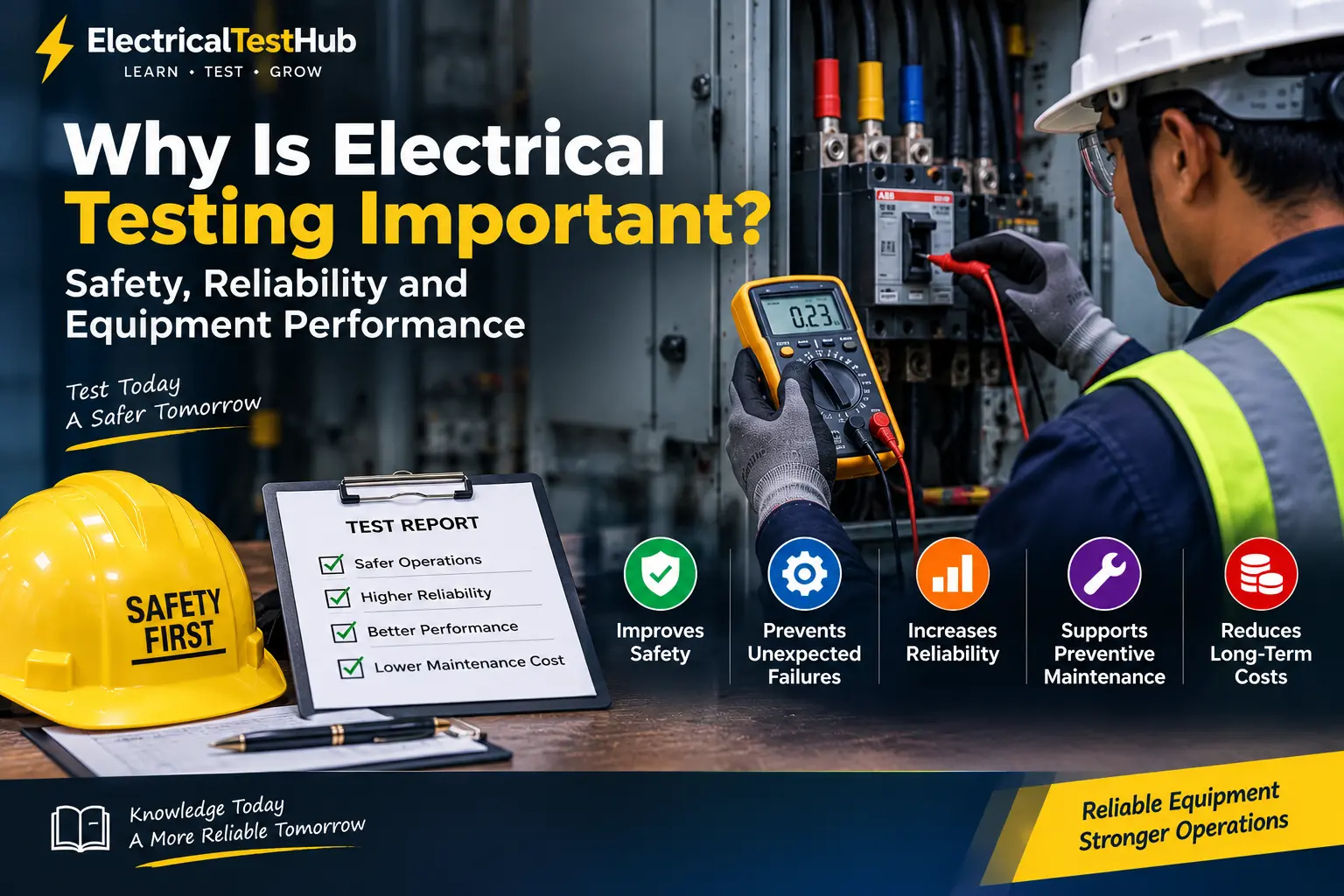
Electrical systems are an essential part of almost every modern facility.
Factories, commercial buildings, hospitals, power plants, substations, data centers, and residential buildings all depend on electrical equipment to operate safely and reliably.
However, electrical equipment does not remain in perfect condition forever.
Over time, components can deteriorate, connections can become loose, insulation can weaken, and hidden faults can develop inside electrical systems.
Many of these problems cannot be identified simply by looking at the equipment.
A transformer may look normal from the outside while its insulation condition is deteriorating. A circuit breaker may appear to be in good condition but fail to operate correctly during a fault. A cable may have internal insulation damage that is impossible to detect through a simple visual inspection.
This is where electrical testing becomes important.
Electrical testing helps engineers and technicians evaluate the condition and performance of electrical equipment. It provides valuable information that can help identify potential problems before they become serious failures.
In this article, we will explain why electrical testing is important and how it contributes to safety, equipment reliability, maintenance, and overall electrical system performance.
Electrical Testing Helps Identify Hidden Problems
One of the most important reasons for electrical testing is that not all electrical problems are visible.
Consider the following examples:
- A cable may have deteriorated insulation.
- A circuit breaker may have high contact resistance.
- A transformer winding may have an internal problem.
- An electrical connection may be loose.
- A motor winding may have insulation deterioration.
- An earthing system may not provide the expected level of protection.
Visual inspection is still important, but it cannot identify every problem.
For example, imagine two electrical cables that appear identical.
Both cables may have clean insulation and no visible physical damage.
However, one cable may have internal insulation deterioration caused by:
- Moisture
- Heat
- Aging
- Mechanical stress
- Contamination
Without appropriate testing, the hidden problem may remain undetected.
Electrical testing allows us to evaluate conditions that cannot always be seen with the human eye.
1. Electrical Testing Improves Safety
The most important reason for electrical testing is often safety.
Electrical faults can create serious hazards, including:
- Electric shock
- Arc flash
- Electrical fires
- Equipment explosions
- Unexpected equipment failure
Regular and appropriate testing can help identify conditions that may increase these risks.
For example, testing may identify:
- Damaged insulation
- Poor grounding connections
- Abnormal circuit breaker operation
- High-resistance connections
- Equipment deterioration
However, an important point must be understood:
Electrical testing does not automatically make equipment safe.
A test result must be correctly interpreted, and appropriate action must be taken when a problem is identified.
For example, if an insulation resistance test indicates poor insulation condition, simply recording the result is not enough.
The engineer or responsible person must investigate the cause and determine the appropriate corrective action.
Electrical testing is therefore part of a larger safety process.
For a better understanding of the hazards associated with electrical work, read our guide on Understanding Electrical Hazards: Shock, Arc Flash and Arc Blast.
2. Electrical Testing Helps Prevent Unexpected Equipment Failure
Electrical equipment often gives warning signs before complete failure occurs.
Unfortunately, these warning signs may not always be visible.
A developing fault may slowly affect the condition of the equipment over weeks, months, or years.
For example:
- Insulation resistance may gradually decrease.
- Contact resistance may gradually increase.
- Transformer test values may begin to change.
- Earth resistance may increase because of environmental conditions.
- A circuit breaker’s operating characteristics may begin to deteriorate.
If testing is performed periodically, these changes may be identified before complete equipment failure occurs.
Real-Life Example
Imagine a critical motor in an industrial facility.
The motor operates continuously and is essential to the production process.
Over time, the insulation of the motor winding begins to deteriorate.
Initially, the motor continues to operate normally.
However, if the insulation continues to weaken, the motor may eventually experience a serious fault.
This could result in:
- Unexpected production shutdown
- Motor damage
- Expensive repairs
- Production losses
Periodic electrical testing may help identify deteriorating insulation before complete failure occurs.
3. Electrical Testing Improves Equipment Reliability
Reliability means the ability of equipment to perform its intended function when required.
For example, a circuit breaker may remain closed for several years without any problem.
However, the real question is:
Will the circuit breaker operate correctly when a fault occurs?
Electrical testing can help evaluate whether critical equipment is capable of performing its intended function.
This is particularly important for equipment such as:
- Circuit breakers
- Protective relays
- Transformers
- Generators
- Motors
- Batteries
- Cables
- Switchgear
Testing can provide valuable information about the operating condition of these assets.
For example:
- Circuit breaker timing tests can evaluate operating performance.
- Contact resistance tests can identify abnormal resistance in current paths.
- Insulation resistance tests can help evaluate insulation condition.
- Transformer ratio tests can help verify transformer winding characteristics.
- Battery tests can provide information about battery condition and performance.
The exact test depends on the equipment and the purpose of the assessment.
4. Electrical Testing Supports Preventive Maintenance
There are different approaches to equipment maintenance.
One approach is to wait until equipment fails and then repair or replace it.
This is often called reactive maintenance.
Another approach is to inspect and evaluate equipment before a failure occurs.
This is part of a preventive or condition-based maintenance strategy.
Electrical testing plays an important role in these maintenance programs.
Reactive Maintenance
The process is simple:
Equipment fails → Problem is identified → Equipment is repaired
The disadvantage is that the failure may already have caused:
- Production loss
- Equipment damage
- Safety concerns
- Emergency repair costs
Preventive Testing
The process is different:
Test the equipment → Identify potential problems → Evaluate the results → Take corrective action when required
This approach can provide an opportunity to address developing problems before a major failure occurs.
However, testing intervals and maintenance requirements should not be selected randomly.
They should consider:
- Equipment type
- Equipment criticality
- Operating environment
- Manufacturer recommendations
- Previous test history
- Applicable standards
- Site maintenance requirements
5. Electrical Testing Helps During Commissioning
Electrical testing is extremely important when new equipment is installed.
Before equipment is placed into normal service, engineers often need to verify that:
- The equipment has been installed correctly.
- Electrical connections are correct.
- Equipment insulation is acceptable.
- Protective systems operate correctly.
- The equipment performs according to its intended purpose.
This process is commonly associated with commissioning and acceptance testing.
Example: New Power Transformer
Before a new transformer is placed into service, several tests may be performed depending on the equipment, project requirements, and applicable standards.
These may include tests related to:
- Insulation condition
- Winding resistance
- Transformer turns ratio
- Other electrical characteristics
The purpose is not simply to collect numbers.
The purpose is to establish confidence that the equipment is suitable for service and to create baseline information for future comparison.
6. Electrical Testing Creates Baseline Data
One of the most valuable benefits of electrical testing is the creation of historical data.
Consider a transformer that is tested when it is new.
The results are recorded.
The transformer is tested again during future maintenance activities.
Now the engineer can compare the results.
For example:
| Test Date | Insulation Test Result | Equipment Condition |
|---|---|---|
| Initial Test | High and stable | Normal |
| After Several Years | Slightly reduced | Monitor trend |
| Later Test | Significant change | Investigation required |
The actual interpretation depends on the equipment, test method, environmental conditions, and applicable criteria.
The important point is that one test result provides information, but multiple test results can reveal a trend.
This is why accurate test records are extremely important.
Trend analysis is often more valuable than looking at a single test result in isolation.
7. Electrical Testing Helps Find the Cause of Problems
Electrical testing is not only used for preventive maintenance.
It is also an important tool for troubleshooting.
Imagine that an electrical motor fails to start.
The cause could be related to:
- Loss of supply voltage
- A damaged cable
- A control circuit problem
- Motor winding damage
- A faulty circuit breaker
- A protection system issue
The technician should not simply guess.
Appropriate electrical measurements and tests can help identify the actual source of the problem.
A systematic troubleshooting process may involve:
- Understanding the problem.
- Reviewing the electrical system.
- Performing a visual inspection.
- Measuring relevant electrical values.
- Performing appropriate tests.
- Comparing the results with relevant requirements or historical data.
- Identifying the likely cause.
This demonstrates another important principle:
Electrical testing helps replace assumptions with measurable information.
8. Electrical Testing Helps Verify Repair Work
After electrical equipment has been repaired, it may be necessary to verify its condition before returning it to service.
For example, after repairing:
- A motor
- A transformer
- A cable
- A circuit breaker
- A switchgear component
appropriate tests may be performed to confirm that the equipment is ready for operation.
Example
Suppose a motor winding has been repaired.
Before the motor is returned to service, appropriate electrical tests may be required to evaluate the condition of the repaired equipment.
The required tests depend on:
- The type of repair
- The equipment
- Manufacturer requirements
- Site procedures
- Applicable standards
Testing after repair can provide additional confidence that the equipment is ready for service.
9. Electrical Testing Helps Protect Critical Systems
Some electrical equipment is more important than others.
For example, an unexpected failure in a critical system can have serious consequences.
Critical electrical systems may be found in:
- Hospitals
- Data centers
- Power plants
- Industrial facilities
- Water treatment plants
- Emergency systems
Consider an emergency generator.
The generator may appear to be in good condition because it is rarely used.
However, it must operate when an emergency occurs.
Appropriate inspection, maintenance, and testing are necessary to establish confidence in its ability to perform when required.
The same principle applies to:
- Emergency batteries
- Protective relays
- Circuit breakers
- Fire protection electrical systems
The most important equipment is often the equipment that must work correctly during an abnormal situation.
10. Electrical Testing Can Reduce Long-Term Costs
Electrical testing requires time, trained personnel, and specialized equipment.
Therefore, some people may consider testing an unnecessary expense.
However, the cost of testing may be significantly lower than the cost of an unexpected equipment failure.
A major electrical failure can result in:
- Emergency repairs
- Equipment replacement
- Production downtime
- Loss of business
- Damage to connected equipment
For example, identifying a deteriorating electrical connection early may allow planned maintenance.
If the problem remains undetected, the connection could eventually overheat and cause significant equipment damage.
The goal is not to test everything unnecessarily.
The goal is to develop an appropriate testing and maintenance strategy based on equipment condition and importance.
11. Electrical Testing Supports Better Engineering Decisions
Electrical testing provides data.
However, data alone is not enough.
The results must be understood and evaluated.
For example, a test report may show:
Insulation Resistance = 500 MΩ
Is this value good or bad?
The answer depends on several factors, including:
- Type of equipment
- Test voltage
- Equipment rating
- Temperature
- Test procedure
- Applicable standards
- Manufacturer recommendations
- Historical test results
This is why electrical testing is more than operating an instrument.
A competent electrical testing professional must understand:
- Why the test is being performed.
- How to perform the test safely.
- How to connect the instrument correctly.
- How to interpret the result.
- What action may be required.
Electrical Testing and Industry Standards
Electrical testing procedures should not be based only on personal experience or assumptions.
Depending on the equipment and application, testing may be performed according to relevant standards, manufacturer instructions, project specifications, and workplace procedures.
Some important international organizations and standards used within the electrical industry include:
IEC Standards
The International Electrotechnical Commission (IEC) publishes standards covering electrical equipment, installations, testing methods, and measuring instruments.
Examples relevant to electrical testing include:
- IEC 60364-6 — Verification of low-voltage electrical installations.
- IEC 61557 series — Equipment used for testing, measuring, or monitoring protective measures in low-voltage distribution systems.
These standards can provide important guidance for specific applications.
IEEE Standards
The Institute of Electrical and Electronics Engineers (IEEE) publishes many standards and guides related to electrical power systems and equipment.
Different IEEE standards and guides may be relevant to specific testing activities involving:
- Transformers
- Motors
- Cables
- Switchgear
- Power systems
The correct standard should always be selected according to the equipment and test being performed.
NFPA 70B
Where applicable, NFPA 70B provides guidance and requirements related to electrical equipment maintenance.
Electrical maintenance programs may include inspection, testing, and evaluation activities for different types of electrical equipment.
Electrical Testing Is Not Just About Passing or Failing
Beginners often think that every electrical test has only two possible outcomes:
- Pass
- Fail
In reality, electrical testing is often more complex.
A result may indicate:
- Normal condition
- A developing problem
- A need for additional testing
- A change that requires monitoring
- A condition requiring immediate investigation
For example, a test value may still appear acceptable but show a significant change compared with previous results.
This change may be more important than the individual number.
Therefore, good electrical testing involves:
Measurement + Comparison + Analysis + Decision
A Simple Real-Life Example
Imagine that you are responsible for maintaining an electrical distribution system.
You perform periodic tests on a circuit breaker.
During the first test, the results are normal.
During the next maintenance cycle, one of the test values has changed slightly.
During the following test, the value changes further.
Although the circuit breaker may still be operating, the trend suggests that something may be changing.
At this point, the responsible engineer can investigate before a serious failure occurs.
This demonstrates the real value of electrical testing.
The purpose of testing is not simply to collect numbers. The purpose is to understand the condition of electrical equipment and make better decisions.
Common Misunderstandings About Electrical Testing
“If the Equipment Is Running, It Must Be Healthy”
Not necessarily.
Many electrical problems develop slowly without immediately stopping the equipment.
“One Test Is Enough”
A single test provides useful information, but historical comparison may provide a better understanding of equipment condition.
“A Good-Looking Test Value Always Means the Equipment Is Perfect”
Test results must be evaluated in the correct context.
One test cannot always identify every possible problem.
“Testing Is Only Required After a Failure”
Testing can also help identify developing problems before failure occurs.
“Any Test Instrument Can Be Used”
The instrument must be suitable for the equipment and the required measurement.
Key Takeaways
Electrical testing is important because it helps engineers and technicians:
- Identify hidden electrical problems.
- Improve workplace and equipment safety.
- Prevent unexpected equipment failure.
- Improve system reliability.
- Support preventive maintenance.
- Verify new installations and equipment during commissioning.
- Create valuable baseline and historical data.
- Troubleshoot electrical problems.
- Verify equipment after repair.
- Protect critical electrical systems.
- Support better maintenance and engineering decisions.
The most important lesson for beginners is this:
Electrical testing is not simply the process of connecting an instrument and reading a value.
A professional electrical testing process involves:
Understanding the equipment → Identifying the correct test → Performing the test safely → Recording the results → Interpreting the data → Taking appropriate action
This approach is what transforms a simple measurement into meaningful engineering information.
What to Learn Next
Now that you understand why electrical testing is important, the next step is to understand the different types of tests used in the electrical industry.
Read our next guide:
Types of Electrical Testing: A Beginner’s Overview
In the next article, we will introduce the major categories of electrical tests and explain where tests such as insulation resistance, continuity, earth resistance, contact resistance, transformer testing, circuit breaker testing, and other diagnostic tests are used.
