

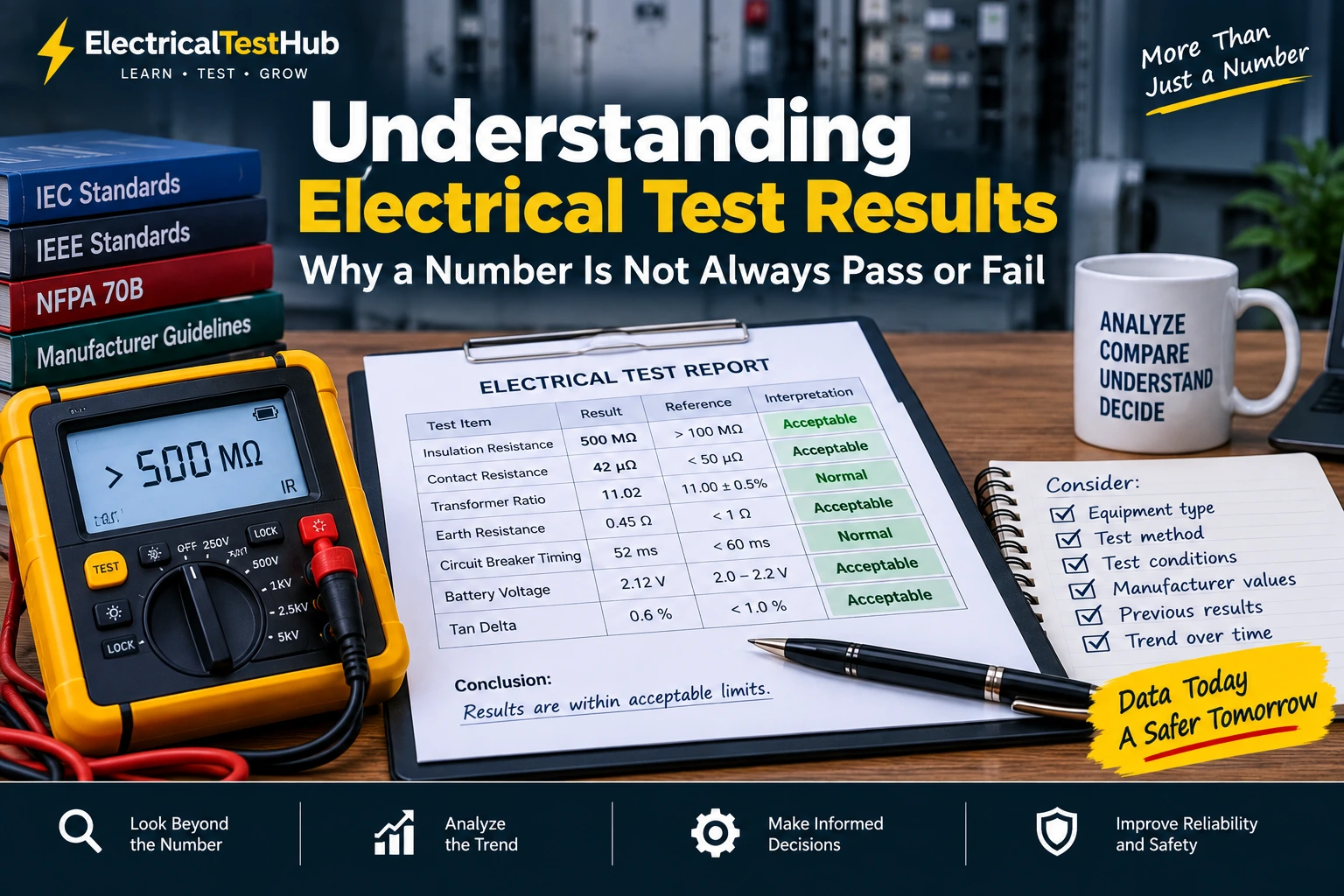
You have completed an electrical test.
The instrument displays a number.
For example:
Insulation Resistance = 500 MΩ
Or:
Contact Resistance = 42 µΩ
Or:
Transformer Ratio = 11.02
The test is complete—but is the equipment good?
For a beginner, this is often the most difficult part of electrical testing.
Many new technicians assume that electrical testing works like a school examination:
- Value is acceptable → PASS
- Value is unacceptable → FAIL
However, real-world electrical testing is often more complicated.
A number by itself does not always tell you the complete condition of electrical equipment.
To understand a test result properly, you may need to consider:
- What equipment was tested?
- Which test was performed?
- How was the test performed?
- What were the test conditions?
- What does the manufacturer recommend?
- Which standard applies?
- What were the previous test results?
This article will help beginners understand one of the most important principles in electrical testing:
A test instrument gives you data. Understanding the data requires context.
The Same Number Can Mean Different Things
Imagine that two technicians perform an insulation resistance test.
Both obtain the same result:
100 MΩ
Does this automatically mean both pieces of equipment are in the same condition?
Not necessarily.
The meaning of the result may depend on:
- Type of equipment
- Voltage rating
- Insulation system
- Test voltage
- Temperature
- Humidity
- Test duration
- Previous test history
This is why professional electrical testing should not simply involve writing a number on a test report.
The number must be interpreted.
The Five Questions to Ask Before Judging a Test Result
Whenever you receive an electrical test result, ask these five questions.
1. What Exactly Was Tested?
First, identify the equipment.
Was it a:
- Power transformer?
- Circuit breaker?
- Motor?
- Cable?
- Battery?
- Protective relay?
Different equipment has different characteristics and testing requirements.
For example, an acceptable result for a low-voltage motor cannot automatically be used as an acceptance criterion for a high-voltage transformer.
2. Which Test Was Performed?
The purpose of the test is extremely important.
Examples include:
- Insulation resistance testing
- Contact resistance testing
- Transformer turns ratio testing
- Circuit breaker timing testing
- Earth resistance testing
Each test measures something different.
For a complete overview, see our guide:
Types of Electrical Testing: A Beginner’s Complete Overview
Before interpreting a result, you must understand:
What question was this test designed to answer?
3. How Was the Test Performed?
The test procedure can significantly affect the result.
Important factors may include:
- Test voltage
- Test duration
- Instrument accuracy
- Connection method
- Equipment temperature
- Environmental conditions
Imagine two technicians testing the same equipment.
If they use different test procedures, directly comparing their results may not always be meaningful.
This is why following an approved and consistent procedure is important.
4. What Reference Should the Result Be Compared With?
A test value should normally be evaluated against an appropriate reference.
This may include:
- Manufacturer recommendations
- Applicable standards
- Project specifications
- Commissioning values
- Historical test data
The reference must be relevant to the specific equipment and test.
Never use a random value from the internet as a universal acceptance criterion.
5. Has the Result Changed Over Time?
One of the most valuable tools in electrical testing is trend analysis.
Suppose a piece of equipment produces the following results.
| Test Year | Result |
|---|---|
| 2022 | 1,200 MΩ |
| 2023 | 1,050 MΩ |
| 2024 | 820 MΩ |
| 2025 | 510 MΩ |
| 2026 | 190 MΩ |
An individual result may not tell the entire story.
However, the trend shows a significant change.
The important question becomes:
Why is the value changing?
This may require further investigation.
The Four Levels of Electrical Test Result Interpretation
For beginners, it is useful to think about test results in four levels.
Level 1: The Raw Value
This is the number displayed by the instrument.
Example:
2.5 Ω
At this stage, it is simply data.
Level 2: The Reference Value
Now compare the result with an appropriate reference.
This could be:
- Manufacturer criteria
- Applicable standard
- Commissioning data
- Previous test results
Now the number starts to become meaningful.
Level 3: The Trend
Compare the current result with historical values.
Ask:
- Is it stable?
- Is it improving?
- Is it gradually deteriorating?
- Has it suddenly changed?
Trend analysis often provides information that a single test cannot provide.
Level 4: The Engineering Decision
Finally, decide what the result means for the equipment.
Possible decisions include:
- Continue normal operation
- Monitor the equipment
- Repeat the test
- Perform additional testing
- Schedule maintenance
- Investigate immediately
- Remove the equipment from service
The test value itself does not make this decision.
The result must be evaluated in context.
A Practical Example: Insulation Resistance
Let’s consider a simplified example.
A technician performs an insulation resistance test on an electrical motor.
The result is:
300 MΩ
A beginner may immediately ask:
Is 300 MΩ good or bad?
The correct answer is:
We need more information.
We may need to know:
- Motor voltage rating
- Type of insulation
- Test voltage used
- Motor temperature
- Test duration
- Previous test results
Now consider another situation.
The same motor produced these results:
| Test Date | Insulation Resistance |
|---|---|
| First Test | 2,000 MΩ |
| Second Test | 1,500 MΩ |
| Third Test | 900 MΩ |
| Current Test | 300 MΩ |
The current value may require more attention because of the significant downward trend.
This demonstrates an important principle:
The direction of change can sometimes be as important as the value itself.
IEEE has historically provided guidance on measuring and interpreting insulation resistance characteristics for electric machinery, emphasizing that test procedures and interpretation are equipment-specific rather than based on a single universal number.
A Practical Example: Contact Resistance
Suppose you perform a contact resistance test on a circuit breaker.
The instrument provides the following results.
| Phase | Contact Resistance |
|---|---|
| R Phase | 28 µΩ |
| Y Phase | 30 µΩ |
| B Phase | 78 µΩ |
A beginner might focus only on the highest value.
However, a professional should ask additional questions:
- Why is one phase significantly different?
- What are the manufacturer’s reference values?
- What were the previous results?
- Was the test connection correct?
- Was the breaker mechanism in the correct position?
An unusual difference between similar phases may be worth investigating.
However:
A difference does not automatically prove that equipment has failed.
The result should be verified and evaluated using the appropriate criteria.
A Practical Example: Transformer Turns Ratio
Consider a transformer ratio test.
The expected ratio depends on:
- Transformer design
- Winding configuration
- Tap position
- Nameplate data
Suppose the test result appears different from the expected value.
Before declaring a failure, check:
- Was the correct transformer nameplate information used?
- Was the tap changer position correctly recorded?
- Were the correct test connections used?
- Was the vector group properly considered?
A test result can sometimes appear abnormal because of incorrect test setup rather than an actual equipment problem.
This is one reason why beginners should never rush to declare equipment defective.
The Three Possible Sources of an Abnormal Result
When a test result appears unusual, the problem may come from three places.
1. The Equipment
The equipment may actually have a developing or existing problem.
Examples include:
- Insulation deterioration
- Loose connections
- Damaged contacts
- Winding problems
2. The Test Method
The procedure may have affected the result.
Examples include:
- Incorrect test voltage
- Incorrect test duration
- Improper connections
- Incorrect test sequence
3. The Test Instrument
The instrument itself may need attention.
Possible issues include:
- Incorrect settings
- Calibration concerns
- Damaged test leads
- Poor connections
- Instrument limitations
This creates an important troubleshooting rule:
An abnormal result should first be investigated—not automatically blamed on the equipment.
Repeatability: Can You Get the Same Result Again?
A good testing process should produce results that are reasonably repeatable when conditions remain similar.
Imagine this situation.
First Test
500 MΩ
Second Test
110 MΩ
Third Test
480 MΩ
If there was no meaningful change in the equipment, these significantly different values should raise questions.
Possible causes may include:
- Poor test connections
- Environmental changes
- Different test duration
- Instrument settings
- Measurement error
Before making an important maintenance decision, it may be necessary to investigate the inconsistency.
The Importance of Test Conditions
Electrical test results can be affected by the surrounding environment and equipment condition.
Important factors may include:
Temperature
Electrical resistance and insulation characteristics can change with temperature.
Therefore, some test methods require temperature consideration or correction when comparing results.
Humidity
High humidity can affect insulation surfaces and measurement results.
Contamination
Dust, moisture, oil, and other contamination can influence some electrical tests.
Equipment Condition
A machine that has been operating continuously may produce different results from the same machine after it has been isolated and allowed to cool.
Therefore, good test reports should record important conditions.
Why a Single PASS or FAIL Result Can Be Dangerous
Imagine a report that contains only:
PASS
A future technician may not know:
- What value was measured?
- Which instrument was used?
- What test voltage was applied?
- What procedure was followed?
- What conditions existed during the test?
A detailed test record provides much more value.
A good test report should normally include information such as:
- Equipment identification
- Test type
- Test date
- Test instrument
- Test conditions
- Measured values
- Applicable reference
- Technician or test engineer
- Observations
This information helps future technicians understand and compare the results.
Standards Are Important—but Standards Must Be Applied Correctly
Electrical testing standards provide important guidance, but a standard should never be used without understanding its scope.
For example, IEC 60364-6 addresses verification of low-voltage electrical installations and includes requirements for inspection, testing, and reporting as part of verification activities.
However, a standard designed for one application should not automatically be used as the acceptance criterion for completely different equipment.
Before applying a standard, ask:
- Does this standard apply to my equipment?
- Does it apply to this type of test?
- Which edition is required by the project or site?
- Are there manufacturer-specific requirements?
The correct standard is useful. The wrong standard can lead to the wrong conclusion.
The “Good Result, Bad Equipment” Situation
This may sound strange, but a piece of equipment can sometimes receive a good result in one test while still having another problem.
For example:
A motor may have acceptable insulation resistance but still experience:
- Bearing problems
- Mechanical vibration
- Supply voltage problems
- Loose electrical connections
Similarly, a circuit breaker may have acceptable contact resistance while experiencing an operating mechanism problem.
This is why:
One successful test does not prove that every part of the equipment is healthy.
Different tests evaluate different characteristics.
The “Bad Result, Good Equipment” Situation
The opposite situation can also occur.
An apparently abnormal result may be caused by:
- Incorrect test connections
- Incorrect instrument settings
- Environmental conditions
- Incorrect test procedure
Therefore, when an unexpected result is obtained:
Do not panic.
Do not immediately energize the equipment.
Do not immediately declare the equipment defective.
Instead:
- Review the procedure.
- Check the test connections.
- Verify the instrument.
- Review environmental conditions.
- Repeat the test when appropriate.
- Compare with relevant references.
- Consult qualified engineering personnel when necessary.
A Practical Result Interpretation Framework
Whenever you receive an electrical test result, use the following process.
Step 1: Record the Exact Value
Do not rely on memory.
Record the complete result.
Step 2: Record the Test Conditions
Include important information such as:
- Test voltage
- Temperature
- Equipment status
- Tap position, where applicable
- Test duration
Step 3: Compare With the Correct Reference
Check:
- Manufacturer recommendations
- Applicable standards
- Project requirements
- Baseline values
Step 4: Compare With Historical Results
Ask:
Has this value changed significantly?
Step 5: Investigate Abnormal Results
Do not assume that the equipment is automatically defective.
Check the complete testing process.
Step 6: Decide What Happens Next
The next action may be:
| Result Condition | Possible Action |
|---|---|
| Stable and satisfactory | Continue normal maintenance |
| Slight change | Monitor future trend |
| Significant change | Investigate further |
| Clearly abnormal | Take appropriate corrective action |
| Inconsistent results | Verify and repeat testing |
The final decision should always consider the specific equipment and applicable requirements.
Real-World Example: The Importance of Historical Data
Imagine two identical circuit breakers.
Both are tested today.
Circuit Breaker A
Current result:
35 µΩ
Previous results:
34 µΩ → 35 µΩ → 35 µΩ
The results appear stable.
Circuit Breaker B
Current result:
35 µΩ
Previous results:
12 µΩ → 16 µΩ → 24 µΩ → 35 µΩ
Both breakers currently have the same value.
However, their histories are different.
Circuit Breaker B shows a significant increasing trend that may deserve further attention.
This demonstrates why:
A test report without historical data can tell only part of the story.
Common Mistakes Beginners Make When Reading Test Results
Mistake 1: Looking Only at the Number
Always consider the equipment and test conditions.
Mistake 2: Searching Online for One “Acceptable Value”
There is rarely one universal number for every situation.
Mistake 3: Ignoring Previous Results
Historical trends can reveal developing problems.
Mistake 4: Assuming the Instrument Cannot Be Wrong
Test instruments and connections must also be verified.
Mistake 5: Ignoring Manufacturer Recommendations
The manufacturer understands the specific design of the equipment.
Mistake 6: Treating Every Test as PASS or FAIL
Some results require monitoring or further investigation rather than an immediate pass-or-fail decision.
A Better Way to Think About Electrical Test Results
Instead of asking only:
Did the equipment pass?
Ask:
Question 1
What did the test measure?
Question 2
Is the result technically reasonable?
Question 3
What should I compare it with?
Question 4
Has the value changed over time?
Question 5
Could the test method have influenced the result?
Question 6
What additional information is needed before making a decision?
This approach helps transform a beginner from someone who simply operates a test instrument into someone who understands the testing process.
Key Takeaways
The most important lesson in electrical testing is:
A number is not a conclusion.
Before interpreting a result, consider:
- Equipment type
- Test method
- Test conditions
- Applicable standards
- Manufacturer recommendations
- Historical results
- Equipment operating history
A professional electrical testing process follows this path:
Measure → Record → Compare → Analyze → Investigate → Decide
For beginners, remember:
The instrument can tell you what it measured. It cannot always tell you why the value changed or what decision should be made.
Learning to interpret electrical test results is therefore one of the most important skills you can develop as an electrical testing professional.
What to Learn Next
You now understand that an electrical test result must be interpreted in context.
The next step is to understand the language used throughout electrical testing.
In the next article, we will explain:
Common Electrical Testing Terms Every Beginner Should Know
You will learn the practical meaning of terms such as:
- Rated voltage
- Test voltage
- Leakage current
- Resistance
- Insulation
- Accuracy
- Calibration
- Baseline value
- Acceptance criteria
- Diagnostic testing
Understanding these terms will make future electrical testing articles much easier to follow.
