

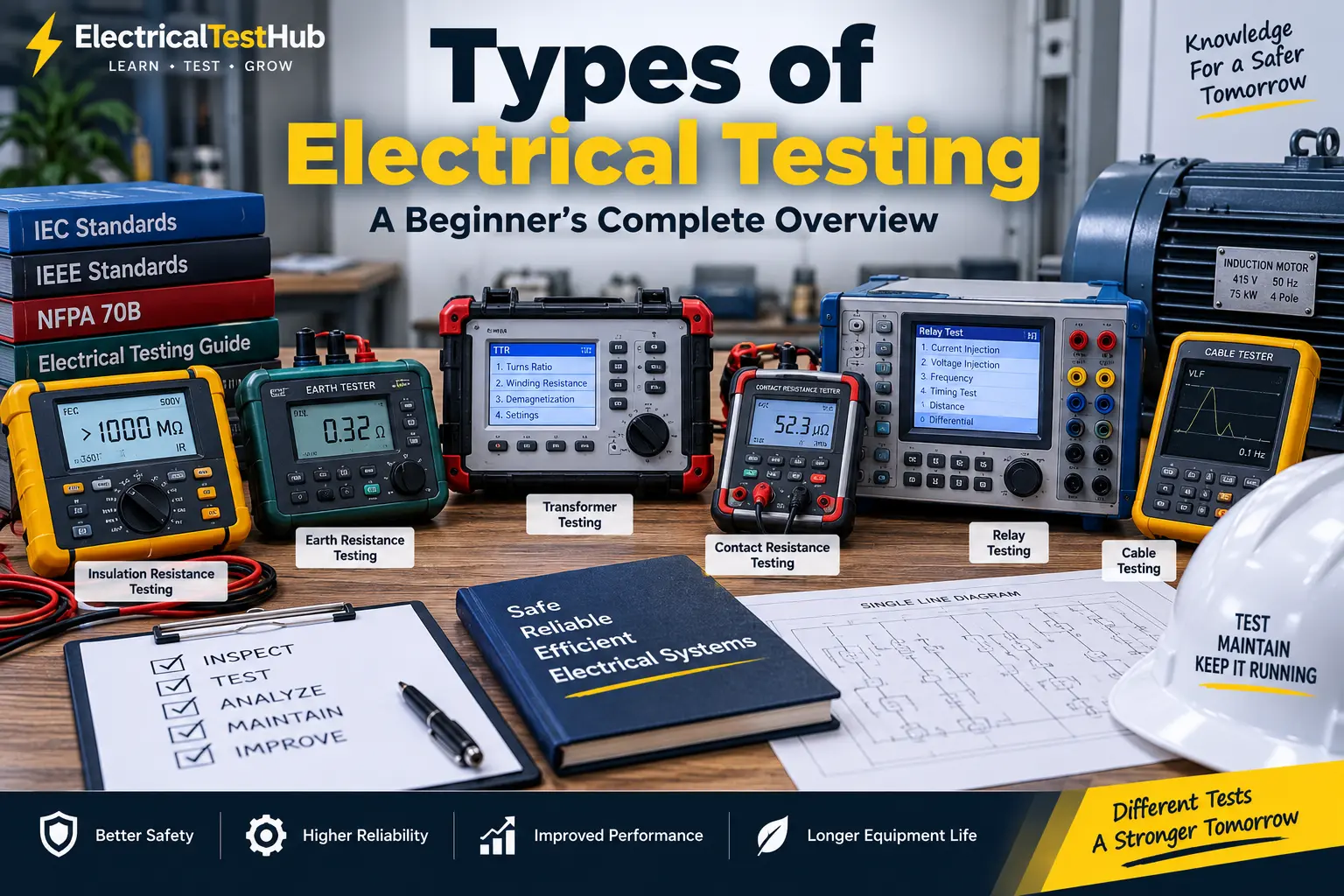
Electrical testing is a broad field.
When someone first enters the electrical testing industry, they may hear terms such as:
- Insulation resistance test
- Continuity test
- Earth resistance test
- Contact resistance test
- Transformer turns ratio test
- Circuit breaker timing test
- Tan Delta test
- Battery discharge test
For a beginner, these names can be confusing.
A common question is:
Why are there so many different types of electrical tests?
The simple answer is that electrical equipment can develop many different types of problems.
One test cannot identify every problem.
For example, an insulation resistance test may provide information about insulation condition, but it cannot tell you whether a circuit breaker will open at the correct speed. Similarly, a circuit breaker timing test cannot determine the condition of a transformer’s winding insulation.
Different equipment and different electrical problems require different testing methods.
This article provides a beginner-friendly overview of the major types of electrical testing and explains what each type of test is generally used for.
Important: This article provides an introductory overview. The correct test method, test voltage, acceptance criteria, and safety procedure depend on the equipment, manufacturer instructions, project specifications, and applicable standards.
Why Are Different Electrical Tests Required?
Electrical equipment contains many different components.
For example, a power transformer may contain:
- Windings
- Insulation
- Bushings
- Tap changers
- Oil
- Cooling systems
- Internal connections
Each component can develop different types of problems.
Therefore, engineers may perform different tests to evaluate different aspects of equipment condition.
A simple way to understand electrical testing is:
Different electrical tests answer different questions.
For example:
| Question | Possible Type of Test |
|---|---|
| Is the insulation in good condition? | Insulation resistance test |
| Is the electrical path continuous? | Continuity test |
| Is a connection developing high resistance? | Contact resistance test |
| Is the transformer ratio correct? | Transformer turns ratio test |
| Does a circuit breaker operate correctly? | Circuit breaker timing test |
| Is the earthing system performing as expected? | Earth resistance test |
The test selected should always match the equipment and the purpose of the investigation.
The Main Categories of Electrical Testing
Electrical testing can be organized into several broad categories.
For beginners, the following categories are useful:
- Visual and mechanical inspection
- Basic electrical measurement
- Continuity testing
- Insulation testing
- Earthing and grounding testing
- Contact and connection testing
- Transformer testing
- Circuit breaker testing
- Cable testing
- Motor and generator testing
- Battery testing
- Protective relay testing
- High-voltage testing
- Diagnostic and condition assessment testing
- Online and offline testing
Let’s look at each category.
1. Visual and Mechanical Inspection
Before performing an electrical test, the first step is often a visual inspection.
Not every problem requires a complex test instrument to identify.
A visual inspection may reveal:
- Damaged insulation
- Loose connections
- Corrosion
- Overheating marks
- Oil leakage
- Broken components
- Contamination
- Incorrect labeling
- Physical damage
For example, imagine performing an insulation resistance test on a motor.
If the motor terminal box contains moisture, damaged cables, or heavily contaminated terminals, these conditions should be identified before testing begins.
Visual inspection is not a replacement for electrical testing.
However, it is often an important part of the complete inspection and testing process.
2. Basic Electrical Measurement
Basic electrical measurements are among the most common activities performed by electrical technicians.
Typical measurements include:
- Voltage
- Current
- Resistance
- Frequency
- Power
- Power factor
These measurements can help technicians understand the operating condition of an electrical system.
Example
If a motor is expected to receive 415 V but the measured voltage is significantly different, this may indicate a problem with the electrical supply or system.
Basic measurements are frequently used during:
- Installation
- Commissioning
- Troubleshooting
- Maintenance
- Routine inspections
A measurement instrument should always be appropriate for the electrical system and measurement being performed.
3. Continuity Testing
A continuity test is used to determine whether an electrical path is complete.
In simple terms, it helps answer:
Is there an unbroken electrical connection between two points?
Continuity testing may be used for:
- Conductors
- Cables
- Protective conductors
- Electrical connections
- Control circuits
Simple Example
Imagine a conductor connecting Point A and Point B.
If the conductor is intact, there should be an electrical path between the two points.
If the conductor is broken, the path may be interrupted.
A continuity test can help identify this condition.
However, beginners should understand that continuity testing is not the same as insulation testing.
Continuity Test
Checks whether a desired electrical path exists.
Insulation Test
Checks whether unwanted electrical leakage paths are properly prevented.
Both tests are important, but they answer different questions.
4. Insulation Resistance Testing
Insulation resistance testing is one of the most common electrical tests.
Electrical conductors are normally separated from each other and from grounded parts by insulation.
Over time, insulation may deteriorate because of:
- Heat
- Moisture
- Dirt
- Oil contamination
- Mechanical damage
- Aging
An insulation resistance test can provide information about the condition of this insulation.
Common equipment tested includes:
- Motors
- Transformers
- Cables
- Generators
- Switchgear
The test is commonly performed using an insulation resistance tester, often called a Megger, although “Megger” is a brand name that is also commonly used informally to describe this type of test.
Important Beginner Concept
High insulation resistance is generally desirable, but the correct interpretation of a result depends on:
- Equipment type
- Test voltage
- Temperature
- Equipment condition
- Applicable standard
- Manufacturer recommendations
- Historical test results
Never judge every insulation resistance result using one universal number.
5. Earth Resistance and Grounding Testing
Earthing and grounding systems play an important role in electrical safety and system performance.
Depending on the application, testing may be performed to evaluate:
- Earth electrode resistance
- Grounding connections
- Protective conductors
- Grounding system performance
An earth resistance test may be performed using specialized test equipment.
Common applications include:
- Substations
- Buildings
- Industrial facilities
- Lightning protection systems
The test method must be selected based on the grounding system and the purpose of the test.
For example, different methods may be used for an individual earth electrode and a large interconnected grounding system.
6. Contact Resistance Testing
Electrical connections should provide a reliable path for current flow.
Over time, a connection may develop increased resistance because of:
- Corrosion
- Oxidation
- Loose connections
- Damaged contacts
- Mechanical wear
A contact resistance test can help identify abnormal resistance in an electrical current path.
This test is commonly associated with equipment such as:
- Circuit breakers
- Disconnectors
- Switches
- Busbar connections
The test is often performed using specialized equipment that applies a suitable test current and measures the voltage drop across the connection.
Why Is It Important?
A high-resistance connection can generate heat during normal operation.
Therefore, abnormal contact resistance may indicate a developing problem.
7. Transformer Testing
Power transformers are critical components in electrical systems.
Because transformers contain multiple components, several different tests may be required.
Common transformer tests include:
- Transformer turns ratio test
- Winding resistance test
- Insulation resistance test
- Power factor or Tan Delta test
- Excitation current test
- Oil testing
- SFRA testing
Each test provides information about a different aspect of transformer condition.
Transformer Turns Ratio Test
Helps verify the relationship between the transformer windings.
Winding Resistance Test
Provides information about winding and connection resistance.
Insulation Resistance Test
Helps evaluate insulation condition.
Tan Delta Test
Can provide additional information about insulation condition.
The results of transformer tests should be evaluated using appropriate procedures, manufacturer information, relevant standards, and historical data.
8. Circuit Breaker Testing
A circuit breaker has an important job.
During normal conditions, it must carry electrical current.
During abnormal conditions, it may need to interrupt fault current.
Therefore, circuit breakers require both mechanical and electrical evaluation.
Common circuit breaker tests include:
- Contact resistance test
- Timing test
- Coil resistance test
- Insulation resistance test
- Trip and close operation tests
- Mechanical operation tests
Circuit Breaker Timing Test
A timing test can evaluate the operating characteristics of a circuit breaker.
For example, the test may examine how long it takes for circuit breaker poles to open or close.
The interpretation of the results depends on the equipment design, manufacturer specifications, and applicable testing requirements.
IEEE C37.09 provides test procedures for AC high-voltage circuit breakers and covers a range of testing and performance-verification activities for breakers above 1,000 V AC.
9. Cable Testing
Electrical cables are essential for transferring electrical power between equipment.
Cable problems can develop because of:
- Aging
- Mechanical damage
- Moisture
- Installation problems
- Thermal stress
- Insulation deterioration
Depending on the cable and purpose of the test, different tests may be performed.
Examples include:
- Continuity testing
- Insulation resistance testing
- High-voltage testing
- VLF testing
- Diagnostic testing
The correct test depends heavily on:
- Cable type
- Voltage rating
- Insulation type
- Installation condition
- Applicable standard
A testing method suitable for one cable may not be appropriate for another.
10. Motor and Generator Testing
Motors and generators contain electrical and mechanical components that require evaluation.
Common electrical tests may include:
- Insulation resistance testing
- Winding resistance testing
- Continuity testing
- Surge testing
- Other diagnostic tests
For large or critical rotating machines, more advanced testing methods may be required.
The purpose may be to evaluate:
- Winding condition
- Insulation condition
- Electrical connections
- Machine performance
11. Battery Testing
Battery systems are important in many electrical installations.
They may provide emergency or backup power for:
- UPS systems
- Substations
- Circuit breaker control systems
- Emergency lighting
- Communication systems
Common battery testing activities include:
- Battery voltage measurement
- Internal resistance or impedance testing
- Capacity testing
- Battery discharge testing
- Charger testing
A battery can sometimes show an acceptable voltage while having reduced capacity.
For this reason, different tests may be required to evaluate different aspects of battery condition.
12. Protective Relay Testing
Protective relays monitor electrical systems and initiate protective actions when abnormal conditions occur.
For example, a protection relay may send a trip signal to a circuit breaker when it detects:
- Overcurrent
- Earth faults
- Differential faults
- Abnormal voltage
- Abnormal frequency
Relay testing helps verify that the protection system performs as intended.
Common testing approaches may include:
- Secondary injection testing
- Primary injection testing
- Functional testing
These tests can evaluate the relay, associated circuits, and in some cases the overall protection system.
13. High-Voltage Testing
Some electrical tests involve the application of a voltage that is higher than the normal operating voltage of the equipment.
These tests may be used to evaluate insulation strength or identify insulation weaknesses.
Examples include:
- AC withstand testing
- DC withstand testing
- VLF testing
- Impulse testing
High-voltage testing introduces significant hazards and should only be performed by qualified personnel using appropriate procedures and safety controls.
Testing equipment and procedures must be selected carefully because an inappropriate test can potentially damage equipment.
More test voltage does not automatically mean a better test.
The correct test method must always be selected for the equipment being tested.
14. Diagnostic and Condition Assessment Testing
Diagnostic testing provides additional information about the condition of electrical equipment.
Unlike a simple pass-or-fail test, diagnostic testing may help identify:
- Aging
- Deterioration
- Developing faults
- Changes in equipment condition
Examples include:
- Tan Delta testing
- Partial discharge testing
- Sweep Frequency Response Analysis (SFRA)
- Frequency response measurements
- Oil analysis
These tests are particularly valuable for critical or expensive equipment.
Example
A transformer may continue operating normally while internal mechanical movement or insulation deterioration is beginning.
Advanced diagnostic tests may help identify signs of such problems before complete failure occurs.
15. Online Testing and Offline Testing
Electrical tests can also be divided into two important categories.
Online Testing
Online testing is performed while equipment remains connected to its normal source of supply or is operating.
Examples may include:
- Thermal monitoring
- Power quality measurements
- Certain partial discharge monitoring activities
Online testing can provide information about equipment under actual operating conditions.
However, it may introduce additional safety considerations.
Offline Testing
Offline testing is generally performed when equipment has been disconnected from its normal electrical supply or is being tested using an external test source.
Examples include:
- Insulation resistance testing
- Contact resistance testing
- Transformer turns ratio testing
- Circuit breaker timing tests
NFPA 70B classifies electrical maintenance testing into online and offline categories, including standard and enhanced testing categories. It also notes that testing equipment while connected to its source of supply can introduce additional hazards.
IEC and IEEE Standards in Electrical Testing
Electrical testing should not be performed using random procedures or personal assumptions.
The appropriate testing method depends on:
- Equipment type
- Equipment voltage
- Test purpose
- Manufacturer requirements
- Project specifications
- Applicable standards
IEC Standards
IEC publishes standards covering electrical installations, equipment, test methods, and testing instruments.
For example, IEC 60364-6 addresses verification of low-voltage electrical installations, including initial and periodic verification.
The IEC 61557 series covers equipment used for testing, measuring, or monitoring protective measures in low-voltage distribution systems. The current consolidated IEC 61557-1 edition incorporates Amendment 1:2024.
IEEE Standards
IEEE publishes standards and guides covering many areas of electrical equipment testing.
For example, IEEE C37.09 addresses test procedures for high-voltage AC circuit breakers.
Different equipment requires different standards.
Therefore, before performing any test, engineers should identify the specific standard or manufacturer recommendation relevant to that equipment.
A Simple Guide for Beginners: Which Test Should I Learn First?
If you are new to electrical testing, you do not need to learn every test at once.
A practical learning path is:
Step 1: Learn Electrical Safety
Before using any electrical test instrument, understand:
- Electrical hazards
- Isolation
- Lockout/Tagout
- Verification of electrical conditions
- Safe work practices
Step 2: Learn Basic Measurements
Understand:
- Voltage
- Current
- Resistance
- Frequency
Step 3: Learn Basic Tests
Start with:
- Continuity testing
- Insulation resistance testing
- Earth resistance testing
Step 4: Learn Equipment-Specific Testing
Then move to:
- Transformer testing
- Circuit breaker testing
- Cable testing
- Motor testing
- Battery testing
Step 5: Learn Advanced Diagnostic Testing
Finally, develop knowledge of:
- Tan Delta
- Partial discharge
- SFRA
- Advanced condition monitoring
This approach makes the learning process easier and more organized.
Common Mistakes Beginners Make
Trying to Learn Only the Test Instrument
Learning which button to press is not enough.
You must understand:
- Why the test is performed
- What the instrument is measuring
- How the equipment should be connected
- What can affect the result
- How the result should be interpreted
Thinking One Test Can Identify Every Problem
Different tests evaluate different conditions.
A good test result in one area does not prove that every component is healthy.
Ignoring Safety Procedures
Electrical testing can introduce additional hazards.
Some tests involve energized equipment or intentionally apply high voltages.
Safety must always be part of the testing procedure.
Comparing Results Without Understanding the Conditions
Test values can be affected by:
- Temperature
- Humidity
- Equipment condition
- Test voltage
- Test duration
Always compare results carefully and under appropriate conditions.
The Most Important Concept: Testing Is a Process
A professional electrical testing process usually follows this sequence:
Understand the Equipment → Select the Correct Test → Prepare Safely → Perform the Test → Record the Results → Analyze the Data → Make an Engineering Decision
This is the foundation of professional electrical testing.
The instrument provides the measurement.
However, the technician or engineer must understand what that measurement means.
Key Takeaways
There are many types of electrical testing because electrical equipment can develop many different types of problems.
Some of the major types include:
- Visual inspection
- Basic electrical measurement
- Continuity testing
- Insulation resistance testing
- Earth resistance testing
- Contact resistance testing
- Transformer testing
- Circuit breaker testing
- Cable testing
- Motor and generator testing
- Battery testing
- Protective relay testing
- High-voltage testing
- Diagnostic testing
The most important lesson for beginners is:
There is no single test that can evaluate every aspect of electrical equipment.
Each test has a specific purpose.
Therefore, before performing a test, always ask:
- What equipment am I testing?
- What problem am I trying to identify?
- Which test is appropriate?
- Which standard or procedure applies?
- How should the result be interpreted?
Understanding these questions is the first step toward becoming a competent electrical testing professional.
What to Learn Next
Now that you understand the major types of electrical testing, the next important question is:
Electrical Testing vs Electrical Inspection: What Is the Difference?
In the next article, we will explain the difference between inspection, measurement, testing, and condition assessment—and why a visual inspection alone cannot always confirm the condition of electrical equipment.
