

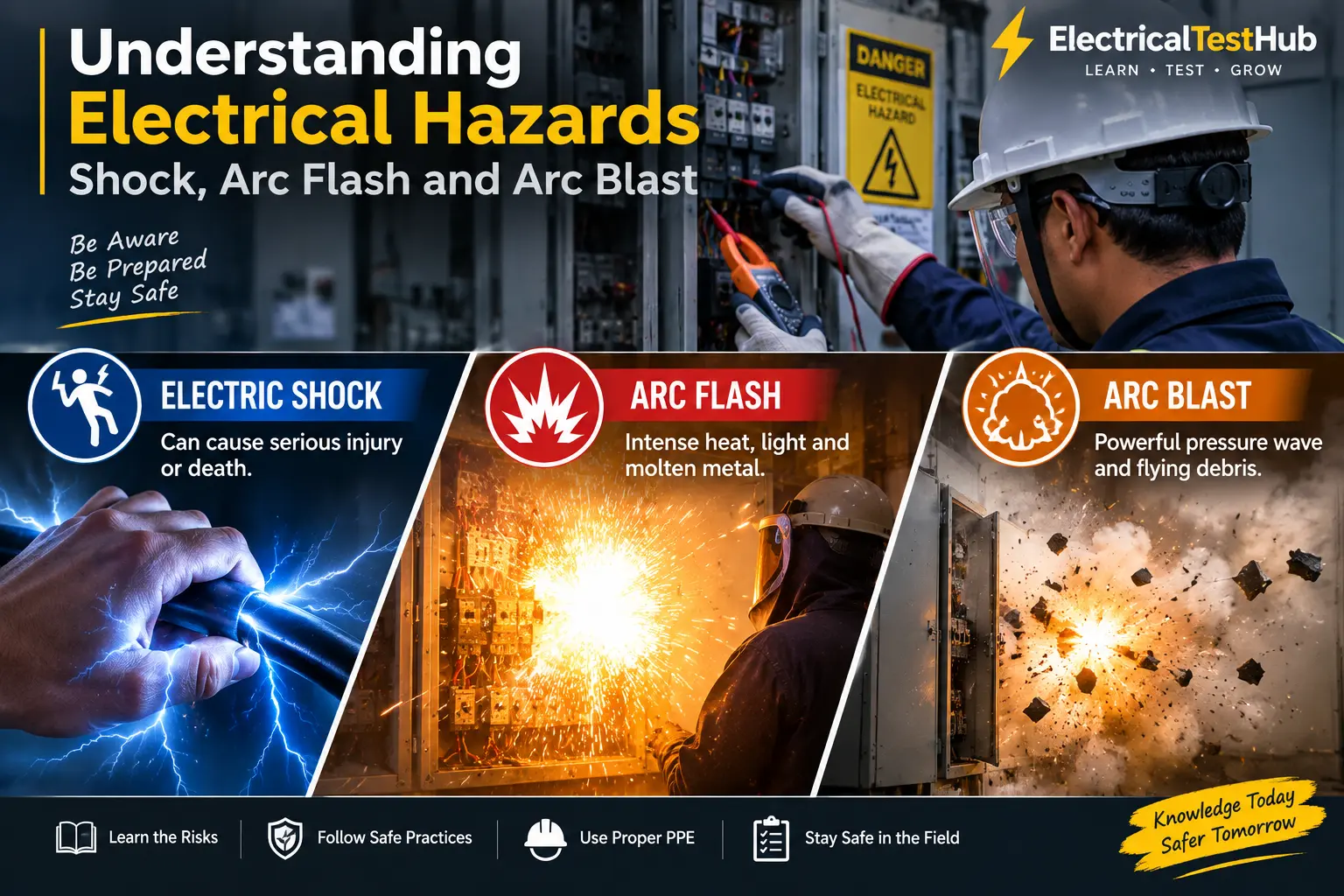
Electrical testing involves working with electrical equipment to measure, inspect, diagnose, and evaluate its condition. Whether you are testing a transformer, circuit breaker, cable, motor, battery, or switchgear, understanding the potential hazards is essential before starting any work.
Many beginners focus primarily on learning how to operate a test instrument. For example, they want to know how to use a multimeter, insulation resistance tester, or earth tester.
However, there is an equally important question that must be answered first:
What can go wrong while performing this test?
Electrical systems can present several serious hazards. Some hazards are visible, while others may exist without any obvious warning.
The three major electrical hazards that every beginner should understand are:
- Electric shock
- Arc flash
- Arc blast
In this article, we will explain these hazards in a simple and practical way and discuss why they are important during real-life electrical testing.
What Is an Electrical Hazard?
An electrical hazard is any condition that can cause injury, death, fire, equipment damage, or other dangerous consequences due to electrical energy.
Electrical hazards may be present in:
- Electrical panels
- Switchgear
- Transformers
- Motors
- Cables
- Generators
- Battery systems
- Distribution boards
- Control panels
- Capacitor banks
- Industrial electrical installations
A dangerous condition does not always mean that you can see sparks or damaged equipment.
For example, an energized conductor may look completely normal.
That is why electrical workers should never judge the safety of equipment based only on its appearance.
1. Electric Shock
Electric shock occurs when electrical current passes through the human body.
The human body can become part of an electrical circuit when a person contacts two points with different electrical potentials.
For example, a person may accidentally touch:
- An energized conductor and ground
- Two energized conductors
- An energized conductor and a grounded metal surface
When current flows through the body, it can cause serious injury.
What Makes Electric Shock Dangerous?
The severity of an electrical shock can depend on several factors.
Voltage
Higher voltage can increase the possibility of dangerous current flowing through the body. However, low-voltage systems should never automatically be considered safe.
The actual danger depends on the complete electrical situation.
Available Current
Electrical current passing through the body can affect muscles, nerves, and vital organs.
The amount of current and the duration of exposure are important factors in determining the severity of an electrical shock.
Duration of Contact
The longer a person remains in contact with an electrical source, the greater the potential risk.
In some situations, electrical current can cause muscle contraction, making it difficult for a person to release the conductor.
Current Path Through the Body
The path taken by electrical current is also important.
For example, current traveling through the upper body may create a more serious risk than current traveling through a less critical path.
Environmental Conditions
Wet or damp conditions can increase electrical risk.
Water and moisture may reduce the resistance of the skin and create a more favorable path for electrical current.
For this reason, electrical testing in wet locations requires additional precautions.
Real-Life Example of Electric Shock
Imagine that a technician is troubleshooting a three-phase electrical panel.
The technician believes that the panel is de-energized because the main circuit breaker is in the OFF position.
However, another power source is still connected to the system.
The technician touches a conductor without verifying the absence of voltage.
If the conductor is energized, electrical current may flow through the person’s body.
The important lesson is simple:
Never rely only on the position of a switch or circuit breaker to determine whether equipment is electrically safe.
The electrical condition must be properly verified using an appropriate procedure and correctly rated test equipment.
2. Arc Flash
An arc flash is a dangerous release of electrical energy caused by an electrical arc fault.
An electrical arc occurs when current travels through the air between conductors or between a conductor and another surface.
During an arc flash, a large amount of energy may be released in a very short time.For additional information about identifying and controlling arc flash hazards, refer to the Occupational Safety and Health Administration (OSHA) guide on electric-arc flash hazards.
This can produce:
- Extremely high temperatures
- Intense light
- Molten metal
- Hot gases
- Severe burns
- Damage to nearby equipment
An arc flash can occur within electrical equipment such as:
- Switchgear
- Motor control centers
- Distribution panels
- Circuit breaker compartments
- Electrical cabinets
How Can an Arc Flash Occur?
Several conditions can contribute to an electrical arc.
Examples include:
Accidental Contact Between Conductors
A metal tool may accidentally create a short circuit between energized parts.
Incorrect Test Probe Placement
During voltage measurement, incorrectly placed probes may accidentally contact multiple points.
This can potentially create a dangerous fault.
Damaged Insulation
Damaged or deteriorated insulation may allow electrical current to travel where it should not.
Loose Connections
Loose electrical connections can generate heat and contribute to equipment failure.
Equipment Failure
Internal faults within electrical equipment can also create an arc fault.
Why Is Arc Flash Important During Electrical Testing?
Some electrical testing activities require technicians to work close to energized equipment.
For example:
- Measuring voltage
- Measuring current
- Troubleshooting energized circuits
- Performing specific diagnostic activities
When working around energized equipment, the possibility of an electrical fault must be considered.
A technician may believe that they are only taking a simple voltage measurement.
However, an incorrect connection, damaged test lead, equipment failure, or unexpected fault can create a dangerous situation.
Therefore, electrical testing should always be properly planned before the test leads are connected.
3. Arc Blast
An arc blast is associated with the rapid release of energy during an electrical arc fault.
While an arc flash is often associated with intense heat and light, an arc blast can create a powerful pressure wave.
This pressure may:
- Throw a person backward
- Move or damage equipment parts
- Produce extremely loud noise
- Release hot gases
- Project molten material
An electrical accident can therefore cause injuries even if a person is not directly touching the energized conductor.
Real-Life Example of Arc Flash and Arc Blast
Imagine that a technician opens a large electrical switchgear compartment for troubleshooting.
A fault develops inside the equipment while energized parts are exposed.
The resulting electrical arc may produce:
- Intense heat
- A bright flash
- A pressure wave
- Hot gases
- Molten metal
The event can occur extremely quickly.
This is why electrical safety involves much more than simply wearing ordinary gloves or being careful not to touch a conductor.
The entire electrical hazard must be understood before work begins.
Other Common Electrical Hazards
Although electric shock, arc flash, and arc blast are major hazards, electrical workers should also be aware of other risks.
4. Electrical Burns
Electrical burns may occur because of:
- Direct contact with electrical energy
- Arc flash exposure
- Contact with hot electrical equipment
Electrical burns can be serious because the damage may not always be limited to the visible surface of the skin.
5. Fire Hazard
Electrical faults can cause fires.
Possible causes include:
- Short circuits
- Overloaded circuits
- Loose connections
- Damaged cables
- Insulation failure
- Equipment overheating
During electrical testing, technicians may identify signs of potential fire hazards.
Examples include:
- Burn marks
- Discoloration
- Melted insulation
- Unusual smells
- Excessive temperature
These warning signs should never be ignored.
6. Stored Electrical Energy
One of the hazards that beginners frequently overlook is stored energy.
Even after the main power supply has been disconnected, some equipment may still contain electrical energy.
Examples include:
- Capacitors
- Battery systems
- UPS systems
- DC circuits
- Power electronic equipment
A technician should never assume that turning OFF the main supply has removed every electrical hazard.
Stored energy must be properly considered before testing begins.
Why Electrical Testing Can Be Dangerous
Electrical testing is different from simply observing electrical equipment.
A test often requires a person to interact directly with the system.
For example, a technician may need to:
- Open electrical panels
- Connect test leads
- Disconnect cables
- Measure voltage
- Inject test signals
- Apply test voltage
- Access electrical terminals
Each activity can introduce additional risks.
Therefore, every test should be approached with three important questions:
Question 1: What energy is present?
Identify all possible electrical energy sources.
Question 2: What can go wrong?
Think about possible hazards before starting work.
Question 3: How can the risk be controlled?
Determine the appropriate safety measures before beginning the test.
Understanding the Difference Between Hazard and Risk
Beginners should understand that a hazard and a risk are not exactly the same thing.
Hazard
A hazard is something that has the potential to cause harm.
For example:
An energized 11 kV electrical conductor is a hazard.
Risk
Risk considers the possibility and potential consequences of exposure to that hazard.
For example, the risk increases if a person must work close to the energized conductor.
Understanding this difference helps technicians perform better risk assessments before electrical work.
How to Control Electrical Hazards
The best approach is not simply to react to hazards.
A safer approach is to identify and control them before starting the work.
A practical safety approach can follow this sequence:
1. Eliminate the Hazard
Whenever possible, remove the electrical energy from the equipment before testing.
For example, perform the test after properly isolating and de-energizing the equipment.
2. Control the Energy Source
If equipment must be isolated, ensure that it cannot be unexpectedly energized.
Proper isolation and workplace control procedures are important.
3. Use Safe Work Procedures
Follow an approved procedure appropriate for the equipment and test.
Do not create your own procedure based only on previous experience or assumptions.
4. Use Appropriate Test Equipment
The test instrument must be suitable for the electrical system and the measurement being performed.
Check:
- Voltage rating
- Measurement category
- Test lead condition
- Instrument condition
5. Use Appropriate PPE
Personal protective equipment may provide additional protection against identified hazards.
However, PPE should never be considered the first or only safety control.
The goal should always be to reduce the hazard as much as reasonably possible before relying on personal protective equipment.
Anyone working around energized electrical equipment should understand the potential consequences of an arc fault and follow appropriate hazard assessment and protection procedures. OSHA provides additional guidance in its Arc Flash Hazard Awareness resource.
A Practical Hazard Assessment Before Testing
Before performing any electrical test, a beginner can use the following simple process.
Step 1: Identify the Equipment
Determine exactly what will be tested.
For example:
- Transformer
- Motor
- Circuit breaker
- Cable
- Switchgear
Do not begin work if the equipment identification is unclear.
Step 2: Identify the Energy Sources
Ask:
- Where does the electrical supply come from?
- Is there a backup source?
- Is there a generator?
- Is there a battery supply?
- Can energy be back-fed into the equipment?
Step 3: Identify the Test Requirement
Determine what type of test will be performed.
For example:
- Voltage measurement
- Insulation resistance test
- Continuity test
- Earth resistance test
Different tests have different hazards.
Step 4: Identify the Possible Hazards
Consider:
- Electric shock
- Arc flash
- Stored energy
- Unexpected energization
- Incorrect connections
- Damaged equipment
Step 5: Apply Safety Controls
Determine what actions are required to control the identified risks.
This may include:
- Isolation
- Lockout/tagout
- Verification of electrical condition
- Work permits
- Barriers
- Appropriate PPE
- Proper test instruments
Common Mistakes That Increase Electrical Hazards
Mistake 1: Assuming the Equipment Is Safe
Never assume that equipment is de-energized simply because a breaker is OFF.
Always follow the appropriate verification procedure.
Mistake 2: Ignoring Multiple Energy Sources
Modern electrical systems may have several energy sources.
A generator, UPS, battery, or alternate supply can energize equipment unexpectedly.
Mistake 3: Using an Incorrect Test Instrument
A test instrument must be suitable for the system being tested.
Using the wrong equipment can create a dangerous situation.
Mistake 4: Using Damaged Test Leads
Cracked insulation or exposed conductors on a test lead can create a serious electrical hazard.
Always inspect the instrument and accessories before use.
Mistake 5: Rushing the Work
Many electrical accidents occur because people skip important safety steps.
Never allow pressure to complete a job quickly to compromise safety.
A Simple Rule for New Electrical Testers
For every electrical testing activity, remember:
Identify the hazard → Assess the risk → Apply controls → Verify safety → Perform the test
This process should become a habit.
A skilled electrical tester is not simply someone who knows how to operate an instrument.
A truly competent tester understands:
- The electrical system
- The purpose of the test
- The possible hazards
- The correct test procedure
- The necessary safety controls
Key Takeaways
Before moving forward with practical electrical testing, remember these important points:
- Electrical hazards are not always visible.
- Electric shock can occur when the human body becomes part of an electrical circuit.
- Arc flash can release extremely high levels of heat and energy.
- Arc blast can create dangerous pressure waves and project materials.
- Electrical equipment may contain stored energy even after the main supply is disconnected.
- Multiple power sources may energize the same equipment.
- Every electrical test should begin with hazard identification.
- Appropriate safety controls must be established before testing begins.
- Never assume that electrical equipment is safe to touch.
- Proper training, procedures, and authorization are essential for electrical work.
Safety is not a separate part of electrical testing. Safety is the first step of every electrical test.
What to Learn Next
Understanding electrical hazards is only the first step.
The next important topic is:
Electrical Safety Before Testing: A Complete Pre-Test Safety Checklist
In the next article, we will create a practical step-by-step checklist that beginners can use before starting electrical testing work.
